








Digitalisation, Techno-stressor, and Digital Readiness: Their Effects on Job Stress and MSMEs’ Performance
Abstract
Keywords
Full Text:
PDFReferences
Alfehaid, M. M., Hassan, T. H., Alfisal, A. A., Saleh, M. I., Bumbak, S. V., & Helal, M. Y. (2024). Post-Pandemic Digital Transformation: Mitigating Technostressand Increasing Well-Being in the Hospitality Industry via the Person-Technology Fit Model. GeoJournal of Tourism and Geosites, 53(2), 388–399. https://doi.org/10.30892/gtg.53202-1214
Bakker, A.B. Demerouti, E. (2010). The Job Demands-Resources model: state of the art. Journal of Managerial Psychology, Vol. 22 Issue: 3, Pp.309-328., Unit 07.
Bakker, A. B., Demerouti, E., & Sanz-Vergel, A. (2023). Job Demands–Resources Theory: Ten Years Later. Annual Review of Organizational Psychology and Organizational Behavior, 10. https://doi.org/https://doi.org/10.1146/annurev-orgpsych-120920-053933
Becker, J., Derra, N. D., Regal, C., & Kühlmann, T. M. (2022). Mitigating the negative consequences of ICT use: the moderating effect of active-functional and dysfunctional coping. Journal of Decision Systems, 31(4), 374–406. https://doi.org/10.1080/12460125.2021.1901337
Bregenzer, A., & Jimenez, P. (2021). Risk Factors and Leadership in a Digitalized Working World and Their Effects on Employees’ Stress and Resources: Web-Based Questionnaire Study. Journal of Medical Internet Research, 23(3), e24906. https://doi.org/10.2196/24906
Brivio, E., Gaudioso, F., Vergine, I., Mirizzi, C. R., Reina, C., Stellari, A., & Galimberti, C. (2018). Preventing Technostress Through Positive Technology. Frontiers in Psychology, 9. https://doi.org/10.3389/fpsyg.2018.02569
Cavicchioli, M., Demaria, F., Nannetti, F., Scapolan, A. C., & Fabbri, T. (2025). Employees’ attitudes and work-related stress in the digital workplace: an empirical investigation. Frontiers in Psychology, 16. https://doi.org/10.3389/fpsyg.2025.1546832
Demerouti, E., Nachreiner, F., Bakker, A. B., & Schaufeli, W. B. (2001). The job demands-resources model of burnout. Journal of Applied Psychology, 86(3). https://doi.org/10.1037/0021-9010.86.3.499
Dragano, N., & Lunau, T. (2020). Technostress at work and mental health: concepts and research results. Current Opinion in Psychiatry, 33(4), 407–413. https://doi.org/10.1097/YCO.0000000000000613
Fischer, T., Reuter, M., & Riedl, R. (2021). The Digital Stressors Scale: Development and Validation of a New Survey Instrument to Measure Digital Stress Perceptions in the Workplace Context. Frontiers in Psychology, 12. https://doi.org/10.3389/fpsyg.2021.607598
Fonseca, L. M. (2018). Industry 4.0 and the digital society: concepts, dimensions and envisioned benefits. Proceedings of the International Conference on Business Excellence, 12(1), 386–397. https://doi.org/10.2478/picbe-2018-0034
Ghafoor, A., & Haar, J. (2022). Does job stress enhance employee creativity? Exploring the role of psychological capital. Personnel Review, 51(2), 644–661. https://doi.org/10.1108/PR-08-2019-0443
Ghahremani-Nahr, J., & Nozari, H. (2021). A Survey for Investigating Key Performance Indicators in Digital Marketing. International Journal of Innovation in Marketing Elements, 1(1), 1–6. https://doi.org/10.59615/ijime.1.1.1
Gimpel, H., Lanzl, J., Regal, C., Urbach, N., Becker, J., & Tegtmeier, P. (2025). Stress from Digital Work: Toward a Unified View of Digital Hindrance Stressors. Information Systems Research, 36(2), 896–915. https://doi.org/10.1287/isre.2022.0691
Golz, C., Peter, K. A., Müller, T. J., Mutschler, J., Zwakhalen, S. M. G., & Hahn, S. (2021). Technostress and Digital Competence Among Health Professionals in Swiss Psychiatric Hospitals: Cross-sectional Study. JMIR Mental Health, 8(11), e31408. https://doi.org/10.2196/31408
Hair, J. F., Hult, G. T. M., Ringle, C. M., & Sarstedt, M. (2022). A primer on partial least squares structural equation modeling (PLS-SEM). In SAGE Publications, Inc. (Issue 1).
Han, S. (2024). Digitalization and job stress: exploring the mediating roles of job and personal aversion risk with gender as a moderator. Frontiers in Psychology, 15. https://doi.org/10.3389/fpsyg.2024.1370711
Händel, M., Stephan, M., Gläser-Zikuda, M., Kopp, B., Bedenlier, S., & Ziegler, A. (2022). Digital readiness and its effects on higher education students’ socio-emotional perceptions in the context of the COVID-19 pandemic. Journal of Research on Technology in Education, 54(2), 267–280. https://doi.org/10.1080/15391523.2020.1846147
Huang, C.-L., & Haried, P. (2020). An Evaluation of Uncertainty and Anticipatory Anxiety Impacts on Technology Use. International Journal of Human–Computer Interaction, 36(7), 641–649. https://doi.org/10.1080/10447318.2019.1672410
Kaltenegger, H. C., Marques, M. D., Becker, L., Rohleder, N., Nowak, D., Wright, B. J., & Weigl, M. (2024). Prospective associations of technostress at work, burnout symptoms, hair cortisol, and chronic low-grade inflammation. Brain, Behavior, and Immunity, 117, 320–329. https://doi.org/10.1016/j.bbi.2024.01.222
Kock, N. (2015). Common method bias in PLS-SEM : A full collinearity assessment approach. 1–10.
La Torre, G., De Leonardis, V., & Chiappetta, M. (2020). Technostress: how does it affect the productivity and life of an individual? Results of an observational study. Public Health, 189, 60–65. https://doi.org/10.1016/j.puhe.2020.09.013
Lanzl, J. (2023). Social Support as Technostress Inhibitor. Business & Information Systems Engineering, 65(3), 329–343. https://doi.org/10.1007/s12599-023-00799-7
Lazarus, R. S., & Folkman, S. (1984). Stress, Appraisal, and Coping. In Health Psychology: A Handbook.
Lee, Y.-K. (2021). Impacts of Digital Technostress and Digital Technology Self-Efficacy on Fintech Usage Intention of Chinese Gen Z Consumers. Sustainability, 13(9), 5077. https://doi.org/10.3390/su13095077
Li, L., Su, F., Zhang, W., & Mao, J. (2018). Digital transformation by entrepreneurs: A capability perspective. Information Systems Journal, 28(6), 1129–1157. https://doi.org/10.1111/isj.12153
Liao, Y., Deschamps, F., Loures, E. de F. R., & Ramos, L. F. P. (2017). Past, present and future of Industry 4.0 - a systematic literature review and research agenda proposal. International Journal of Production Research, 55(12), 3609–3629. https://doi.org/10.1080/00207543.2017.1308576
Makowska-T?omak, E., Bedy?ska, S., Skorupska, K., Nielek, R., Kornacka, M., & Kope?, W. (2023). Measuring digital transformation stress at the workplace–Development and validation of the digital transformation stress scale. PLOS ONE, 18(10), e0287223. https://doi.org/10.1371/journal.pone.0287223
Malik, N., Tripathi, S. N., Kar, A. K., & Gupta, S. (2022). Impact of artificial intelligence on employees working in industry 4.0 led organizations. International Journal of Manpower, 43(2), 334–354. https://doi.org/10.1108/IJM-03-2021-0173
Marjerison, R. K., Han, L., & Chen, J. (2023). Investor Behavior during Periods of Crises: The Chinese Funds Market during the 2020 Pandemic. Review of Integrative Business and Economics Research, 12(1), 71–91.
Marsh, E., Perez Vallejos, E., & Spence, A. (2024). Overloaded by Information or Worried About Missing Out on It: A Quantitative Study of Stress, Burnout, and Mental Health Implications in the Digital Workplace. Sage Open, 14(3). https://doi.org/10.1177/21582440241268830
Martin, L., Hauret, L., & Fuhrer, C. (2022). Digitally transformed home office impacts on job satisfaction, job stress and job productivity. COVID-19 findings. PLOS ONE, 17(3), e0265131. https://doi.org/10.1371/journal.pone.0265131
Matt, C., Hess, T., & Benlian, A. (2015). Digital Transformation Strategies. Business & Information Systems Engineering, 57(5), 339–343. https://doi.org/10.1007/s12599-015-0401-5
Michelotto, F., & Joia, L. A. (2024). Organizational Digital Transformation Readiness: An Exploratory Investigation. In Journal of Theoretical and Applied Electronic Commerce Research (Vol. 19, Issue 4, pp. 3283–3304). https://doi.org/10.3390/jtaer19040159
Morrar, R., & Arman, H. (2017). The Fourth Industrial Revolution (Industry 4.0): A Social Innovation Perspective. Technology Innovation Management Review, 7(11), 12–20. https://doi.org/10.22215/timreview/1117
Mougha, W., Nordin, S. M., Salleh, R., & Abbasi, H. A. (2023). Exploring the Impact of Techno-Complexity and Techno-Uncertainty on Academic Staff’s Job Performance in the Era of Social Networking Stressors. Business Management and Strategy, 14(2), 329. https://doi.org/10.5296/bms.v14i2.21555
Nasir, J., Ibrahim, R. M., Sarwar, M. A., Sarwar, B., Al-Rahmi, W. M., Alturise, F., Samed Al-Adwan, A., & Uddin, M. (2022). The Effects of Transformational Leadership, Organizational Innovation, Work Stressors, and Creativity on Employee Performance in SMEs. Frontiers in Psychology, 13. https://doi.org/10.3389/fpsyg.2022.772104
Nisafani, A. S., Kiely, G., & Mahony, C. (2020). Workers’ technostress: a review of its causes, strains, inhibitors, and impacts. Journal of Decision Systems, 29(sup1), 243–258. https://doi.org/10.1080/12460125.2020.1796286
Pingali, S. R., Singha, S., Arunachalam, S., & Pedada, K. (2023). Digital readiness of small and medium enterprises in emerging markets: The construct, propositions, measurement, and implications. Journal of Business Research, 164, 113973. https://doi.org/10.1016/j.jbusres.2023.113973
QU Zheng. (2024). Digital Readiness and Digital Competences Influence on Information Management System: Organizational Support as Moderator. Profesional de La Información, 33(4). https://doi.org/10.3145/epi.2024.ene.0408
Rademaker, T., Klingenberg, I., & Süß, S. (2025). Leadership and technostress: a systematic literature review. Management Review Quarterly, 75(1), 429–494. https://doi.org/10.1007/s11301-023-00385-x
Rasool, T., Warraich, N. F., & Sajid, M. (2022). Examining the Impact of Technology Overload at the Workplace: A Systematic Review. Sage Open, 12(3). https://doi.org/10.1177/21582440221114320
Samsuden, N. S., Kohar, U. H. A., Khatib, S. F. A., & Abbas, A. F. (2024). Digital Capabilities and Business Performance: A Systematic Literature Review. Sustainability, 16(24), 11108. https://doi.org/10.3390/su162411108
Scheepers, L., Angerer, P., & Dragano, N. (2022). Digitalisation in Craft Enterprises: Perceived Technostress, Readiness for Prevention and Countermeasures—A Qualitative Study. International Journal of Environmental Research and Public Health, 19(18), 11349. https://doi.org/10.3390/ijerph191811349
Sekaran, U. (2021). Research Methods for Busniness. In The Encyclopedia of Research Methods in Criminology and Criminal Justice: Volume II: Parts 5-8.
Sharabati, A.-A. A., Ali, A. A. A., Allahham, M. I., Hussein, A. A., Alheet, A. F., & Mohammad, A. S. (2024). The Impact of Digital Marketing on the Performance of SMEs: An Analytical Study in Light of Modern Digital Transformations. Sustainability, 16(19), 8667. https://doi.org/10.3390/su16198667
Tarafdar, M., Cooper, C. L., & Stich, J. (2019). The technostress trifecta ? techno eustress, techno distress and design: Theoretical directions and an agenda for research. Information Systems Journal, 29(1), 6–42. https://doi.org/10.1111/isj.12169
Trischler, M. F. G., & Li-Ying, J. (2022). Exploring the Relationship Between Multi Dimensional Digital Readiness and Digital Transformation Outcomes. International Journal of Innovation Management, 26(03). https://doi.org/10.1142/S136391962240014X
Upadhyaya, P., & Vrinda. (2021). Impact of technostress on academic productivity of university students. Education and Information Technologies, 26(2), 1647–1664. https://doi.org/10.1007/s10639-020-10319-9
Valta, M., Hildebrandt, Y., & Maier, C. (2024). Fostering the digital mindset to mitigate technostress: an empirical study of empowering individuals for using digital technologies. Internet Research, 34(6), 2341–2369. https://doi.org/10.1108/INTR-09-2022-0766
Wang, K., Shu, Q., & Tu, Q. (2008). Technostress under different organizational environments: An empirical investigation. Computers in Human Behavior, 24(6), 3002–3013. https://doi.org/10.1016/j.chb.2008.05.007
Wrede, S. J. S., Claassen, K., Rodil dos Anjos, D., Kettschau, J. P., & Broding, H. C. (2023). Impact of digital stress on negative emotions and physical complaints in the home office: a follow up study. Health Psychology and Behavioral Medicine, 11(1). https://doi.org/10.1080/21642850.2023.2263068
Xu, M., David, J. M., & Kim, S. H. (2018). The Fourth Industrial Revolution: Opportunities and Challenges. International Journal of Financial Research, 9(2), 90. https://doi.org/10.5430/ijfr.v9n2p90
DOI: https://doi.org/10.32535/ijafap.v9i3.4536
Refbacks
- There are currently no refbacks.
Copyright (c) 2026 Khoirul Hikmah, Arief Subiyantoro, Marita Marita, Rifqi Syarif Nasrulloh, Aditya Wardana, Muhammad Ilham Fawwaz

This work is licensed under a Creative Commons Attribution-NonCommercial-ShareAlike 4.0 International License.
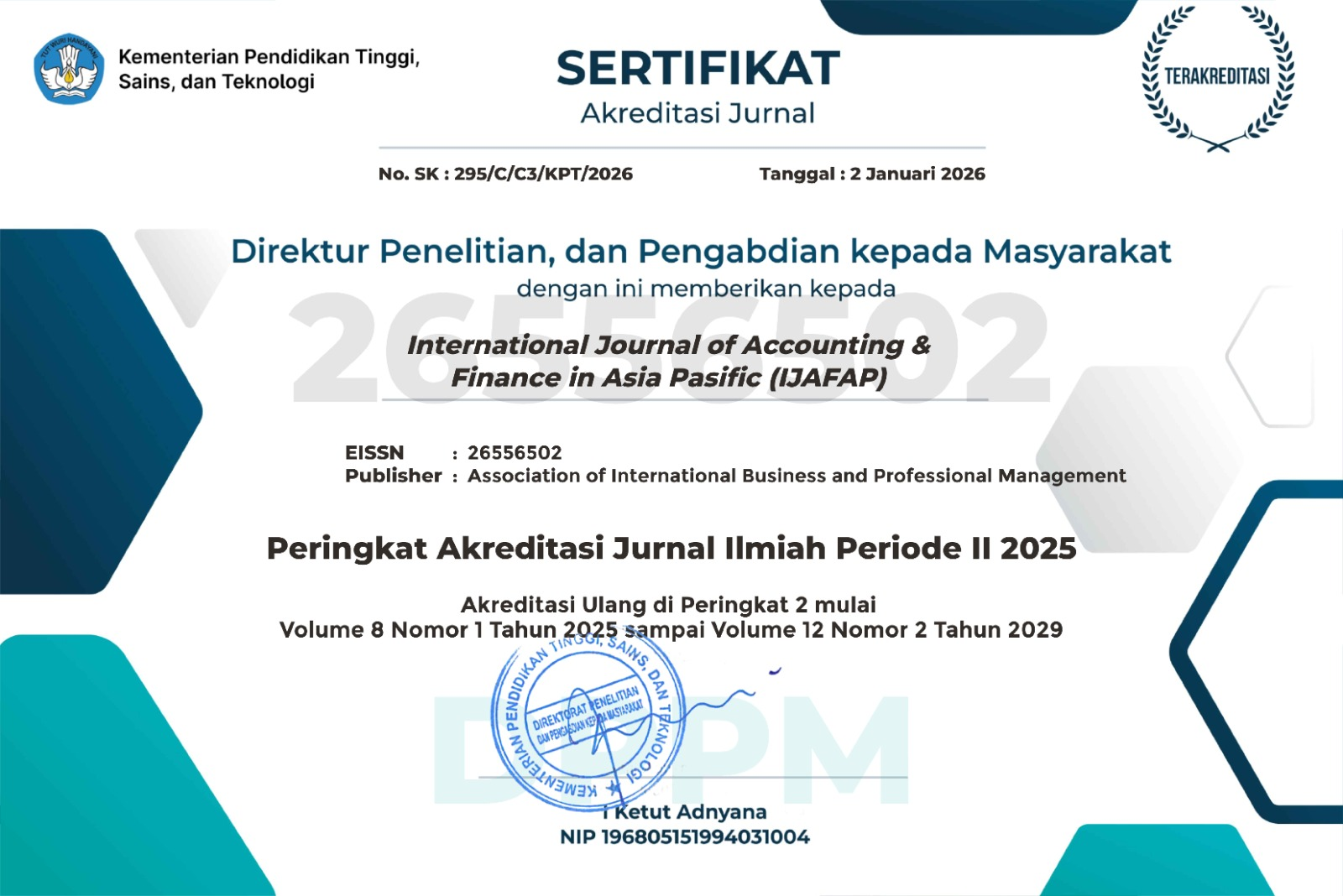
International Journal of Accounting and Finance in Asia Pacific (IJAFAP)
ISSN 2684-9763 (Print) | ISSN 2655-6502 (Online)
DOI Prefix: 10.32535 by CrossRef
Published by AIBPM Publisher
JL. Kawi No. 23, Bareng, Klojen, Kota Malang, Jawa Timur, Indonesia
Email: adm.ijafap@gmail.com
Phone: +62 896-8679-1980
Website: https://ejournal.aibpmjournals.com/index.php/IJAFAP
Governed by
Association of International Business and Professional Management
Email: admin@aibpm.org
Website: https://www.aibpm.org/
Indexed by








Licensing Information

International Journal of Accounting and Finance in Asia Pacific (IJAFAP) is licensed under a Creative Commons Attribution-NonCommercial-ShareAlike 4.0 International License.