








A Double-Edged Sword? Equity Crowdfunding, P2P Lending, and MSME Financial Sustainability: A CIMO-Based Systematic Review
Abstract
The global MSME financing gap estimated at US$5.7 trillion across emerging markets has accelerated scholarly interest in technology-driven alternative financing instruments. Yet whether ECF and P2P lending enhance or undermine the long-term financial sustainability of MSMEs remains unresolved. This study conducts a systematic literature review following PRISMA 2020 guidelines, applying the CIMO framework to synthesize 13 empirical studies published between 2018 and 2026. The configurational analysis identifies four distinct pathways linking alternative financing to MSME financial sustainability. Information asymmetry reduction emerges as the linchpin mechanism across all studies, operating through governance, human capital, social-relational, and visual signaling channels that fundamentally differ from traditional intermediation. ECF functions as a double-edged sword, enhancing innovation yet elevating failure risk depending on governance structure and financial constraint severity. P2P lending improves sustainability within optimal credit thresholds but triggers moral hazard when leverage is excessive. These findings necessitate modifications to pecking order, signaling, and agency theories, and demonstrate that regulatory calibration of investor control rights and post-financing disclosure is essential for converting capital access into sustainable financial outcomes.
Keywords
Full Text:
PDFReferences
Akerlof, G. A. (1978). The market for “lemons”: Quality uncertainty and the market mechanism. In Uncertainty in economics (pp. 235-251). Academic Press.
Alsabah, H., & Alibrahim, A. (2025). Moral hazard in online peer-to-peer lending. Applied Economics, 57(36), 5474-5485.
Buttice, V., Di Pietro, F., & Tenca, F. (2020). Is equity crowdfunding always good? Deal structure and the attraction of venture capital investors. Journal of Corporate Finance, 65, 101773.
Cicchiello, A. F. (2019). Building an entrepreneurial ecosystem based on crowdfunding in Europe: the role of public policy. Journal of Entrepreneurship and Public Policy, 8(3), 297-318.
Cicchiello, A. F., Pietronudo, M. C., Leone, D., & Caporuscio, A. (2021). Entrepreneurial dynamics and investor-oriented approaches for regulating the equity-based crowdfunding. Journal of Entrepreneurship and Public Policy, 10(2), 235-260.
Coakley, J., Cumming, D., Lazos, A., & Vismara, S. (2025). Lead investor nominee in equity crowdfunding. British Journal of Management, 36(4), 1524-1538.
Connelly, B. L., Certo, S. T., Ireland, R. D., & Reutzel, C. R. (2011). Signaling theory: A review and assessment. Journal of management, 37(1), 39-67.
Cummins, M., Lynn, T., Mac an Bhaird, C., & Rosati, P. (2018). Addressing information asymmetries in online peer-to-peer lending. In Disrupting finance: Fintech and strategy in the 21st century (pp. 15-31). Cham: Springer International Publishing.
Dela Cruz, N.A., Villanueva, A.C.B., Tolin, L.A., Salari, G., White, H., 2023. PROTOCOL: Effects of interventions to improve access to financial services for micro-, small- and medium-sized enterprises in low- and middle-income countries: An evidence and gap map. Campbell Syst. Rev. 19 (2), e1325. https://doi.org/10.1002/cl2.1325
Denyer, D., Tranfield, D., 2009. Producing a systematic review, in: Buchanan, D.A., Bryman, A. (Eds.), The SAGE Handbook of Organizational Research Methods. Sage Publications, London, pp. 671–689.
Djabang, P., Shubita, M., Konstantopoulou, A., 2025. Pecking order theory's impact on the financing of small- and medium-sized enterprises (SMEs) in the UK. Int. J. Organ. Anal. 33 (2), 354–374. https://doi.org/10.1108/IJOA-04-2024-4426
Do, T.N.H., Cheema, M.A., Vanacker, T., 2026. Mixed blessings? Venture capitalists, angels, and the performance of equity crowdfunded firms. Small Bus. Econ. 66, 531–550. https://doi.org/10.1007/s11187-025-01113-3
Eldridge, D., Nisar, T.M., Torchia, M., 2021. What impact does equity crowdfunding have on SME innovation and growth? An empirical study. Small Bus. Econ. 57 (2), 765–781. https://doi.org/10.1007/s11187-019-00210-4
Fasano, F., La Rocca, M., Sánchez-Vidal, F.J., Boutouar, Y., 2025. Why SMEs go to crowdfunding? The role of financial constraints and agency issues. Small Bus. Econ. 65, 1183–1207. https://doi.org/10.1007/s11187-025-01046-x
Felipe, I.J. dos S., Oliveira, A.M.B. de, Carvalho, G.B. de, 2025. A taxonomy of equity crowdfunding startups in Brazil. BAR – Braz. Adm. Rev. 22 (3), e240093. https://doi.org/10.1590/1807- 7692bar2025240093
Gaibulloev, K., Mirzaei, A., Moore, T., Saad, M., 2025. The effect of fintech financing on firm performance: Evidence from emerging economies. J. Int. Financ. Mark. Inst. Money 99, 102052. https://doi.org/10.1016/j.intfin.2024.102052
Galema, R., 2020. Credit rationing in P2P lending to SMEs: Do lender-borrower relationships matter? J. Corp. Financ. 65, 101742. https://doi.org/10.1016/j.jcorpfin.2020.101742
Gupta, P., Singh, S., Ghosh, R., Shukla, B., Jain, C., 2024. Regulatory framework on governing equity crowdfunding: A systematic literature review and future directions. J. Financ. Regul. Compliance 32 (5), 630–648. https://doi.org/10.1108/JFRC-06-2024-0099
Hornuf, L., Schwienbacher, A., 2017. Should securities regulation promote equity crowdfunding? Small Bus. Econ. 49 (3), 579–593. https://doi.org/10.1007/s11187-017-9839-9
Hornuf, L., Schmitt, M., Stenzhorn, E., 2018. Equity crowdfunding in Germany and the United Kingdom: Follow-up funding and firm failure. Corp. Gov. Int. Rev. 26 (5), 331–354. https://doi.org/10.1111/corg.12260
IFC, 2025. MSME Finance Gap: An Updated Estimation and Evolution of the Gap. International Finance Corporation, Washington,DC. https://www.smefinanceforum.org/sites/default/files/Data%20Sites%20downloads/I FC%20Report_MAIN%20Final%203%2025.pdf
Jensen, M.C., Meckling, W.H., 1976. Theory of the firm: Managerial behavior, agency costs and ownership structure. J. Financ. Econ. 3 (4), 305–360. https://doi.org/10.1016/0304- 405X(76)90026-X
Junarsin, E., Pelawi, R.Y., Kristanto, J., Marcelin, I., Pelawi, J.B., 2023. Does fintech lending expansion disturb financial system stability? Evidence from Indonesia. Heliyon 9 (9), e18384. https://doi.org/10.1016/j.heliyon.2023.e18384
Kassim, S.F.M., Zain, S.N.M., Zainon, S., Bawono, A.D.B., 2024. Impacts of financial management on equity-crowdfunded firms' performance. J. Sustain. Sci. Manag. 19 (11), 153–176. https://doi.org/10.46754/jssm.2024.11.010
Kgoroeadira, R., Burke, A., Di Pietro, F., van Stel, A., 2023. Determinants of firms' default on unsecured loans in the P2P crowdfunding market. J. Int. Financ. Mark. Inst. Money 89, 101882. https://doi.org/10.1016/j.intfin.2023.101882
Kivilo, S., Tesliuks, A., Lublóy, Á., 2025. Factors influencing US equity-crowdfunded companies' ability to survive. Venture Cap. 27(1),1–30. https://doi.org/10.1080/13691066.2024.2421432
La Porta, R., Lopez-de-Silanes, F., Shleifer, A., Vishny, R.W., 1998. Law and finance. J. Polit. Econ. 106 (6), 1113–1155. https://doi.org/10.1086/250042
Laia, E., Windijarto, 2025. The role of peer-to-peer (P2P) lending in developing countries: A systematic literature review. Int. J. Innov. Sci. Vol. ahead-of-print. https://doi.org/10.1108/IJIS-09-2024-0258
Li, X., Tian, X., 2022. Research on SMEs' reputation mechanism and default risk based on investors' financial participation. Sustainability 14 (21), 14329. https://doi.org/10.3390/su142114329
Mashoene, M., Tweneboah, G., Schaling, E., 2025. FinTech and financial inclusion in emerging and developing economies: A system GMM model. Cogent Soc. Sci. 11 (1), 2447127. https://doi.org/10.1080/23311886.2024.2447127
Mazzocchini, F.J., Lucarelli, C., 2023. Success or failure in equity crowdfunding? A systematic literature review and research perspectives. Manag. Res. Rev. 46 (6), 790–831. https://doi.org/10.1108/MRR-09-2021-0679
Mutsonziwa, K., Fanta, A.B., 2021. Small business performance: Is it access to formal or informal credit that matters? J. Afr. Bus. 22 (4), 550–563. https://doi.org/10.1080/15228916.2020.1826854
Myers, S.C., Majluf, N.S., 1984. Corporate financing and investment decisions when firms have information that investors do not have. J. Financ. Econ. 13 (2), 187–221. https://doi.org/10.1016/0304-405X(84)90023-0
Page, M.J., McKenzie, J.E., Bossuyt, P.M., Boutron, I., Hoffmann, T.C., Mulrow, C.D., Shamseer, L., Tetzlaff, J.M., Akl, E.A., Brennan, S.E., Chou, R., Glanville, J., Grimshaw, J.M., Hróbjartsson, A., Lalu, M.M., Li, T., Loder, E.W., Mayo-Wilson, E., McDonald, S., McGuinness, L.A., Stewart, L.A., Thomas, J., Tricco, A.C., Welch, V.A., Whiting, P., Moher, D., 2021. The PRISMA 2020
statement: An updated guideline for reporting systematic reviews. BMJ 372, n71. https://doi.org/10.1136/bmj.n71
Pham, D.T.N., 2026. The nonlinear fintech-financial stability nexus in Asia-Pacific and the Middle East: When institutional quality and financial efficiency matter. Res. Int. Bus. Financ. 75, 102738. https://doi.org/10.1016/j.ribaf.2025.102738
Qiao, T., 2024. The value and impact of alternative data in micro and small business financing, in: Proceedings of the International Conference on Financial Management and the Digital Economy (ICFMDE 2023). Atlantis Press, pp. 97–103. https://doi.org/10.2991/978-94- 6463-404-4_10
Rao, P., Kumar, S., Chavan, M., Lim, W.M., 2023. A systematic literature review on SME financing: Trends and future directions. J. Small Bus. Manag. 61 (3), 1247–1277. https://doi.org/10.1080/00472778.2021.1955123
Romero Alvarez, Y.P., Salas-Navarro, K., Martínez, L.B., Zamora-Musa, R., 2025. Financing innovation in SMEs: A systematic review of financing channels. Int. J. Innov. Sci. Vol. ahead-of-print. https://doi.org/10.1108/IJIS-06-2024-0151
Sabato, G., Altman, E.I., Andreeva, G., 2021. Small and medium-sized enterprises that borrow from "alternative" lenders in the United Kingdom: Who are they? J. Credit Risk 17 (2), 1–24. https://doi.org/10.21314/JCR.2021.002
Spence, M., 1973. Job market signaling. Q. J. Econ. 87 (3), 355–374. https://doi.org/10.2307/1882010
Stiglitz, J.E., Weiss, A., 1981. Credit rationing in markets with imperfect information. Am. Econ. Rev. 71 (3), 393–410.
Tipaldi, R., Gallucci, C., Liñares-Zegarra, J.M., 2026. Herding behaviour in equity crowdfunding and P2P lending markets: A systematic meta-analysis. Int. Rev. Financ. Anal. 99, 103952. https://doi.org/10.1016/j.irfa.2025.103952
Ullah, S., Begum, M., 2025. FinTech and financial sustainability: A mediating role of financial inclusion. Technol. Forecast. Soc. Chang. 211, 113808.
https://doi.org/10.1016/j.techfore.2024.113808
Vidyarani, K., Mallick, H., 2025. Does credit from various sources improve MSME performance? An empirical analysis for a large transitioning developing economy of India. J. Int. Dev. 37 (1), 208–231. https://doi.org/10.1002/jid.3954
Vismara, S., Wirtz, P., 2025. Fundraising, governance and environmental ethics: Evidence from equity crowdfunding. J. Bus. Ethics 200, 841–865. https://doi.org/10.1007/s10551-024- 05917-3
Walthoff-Borm, X., Vanacker, T., Collewaert, V., 2018. Equity crowdfunding, shareholder structures, and firm performance. Corp. Gov. Int. Rev. 26 (5), 314–330. https://doi.org/10.1111/corg.12259
Wasti, S.M.H.A., Ahmed, J., 2026. Comparative role of quality signals and social network activities in overfunding: Evidence from equity crowdfunding. Int. J. Entrep. Innov. 27 (1), 45–62. https://doi.org/10.1177/14657503241302218
Wojahn, O.W., Wilms, J.F., 2020. The bankruptcy risk of equity crowdfunded companies in Germany, in: Bilgin, M.H., Danis, H., Demir, E., Can, U. (Eds.), Eurasian Economic Perspectives. Eurasian Studies in Business and Economics, vol. 14/2. Springer, Cham, pp. 367–383. https://doi.org/10.1007/978-3-030-53536-0_24
Yan, J., 2025. How the use of alternative information in risk management fintech platforms influences SME lending: A qualitative case study. Qual. Res. Financ. Mark. 17 (2), 348–375. https://doi.org/10.1108/QRFM-06-2024-0164
Yang, J., Xin, J., Zeng, Y., Liu, P.J., 2025. Signaling and perceiving on equity crowdfunding decisions — a machine learning approach. Small Bus. Econ. 64, 1009–1038. https://doi.org/10.1007/s11187-024-00956-2
Ziegler, T., Shneor, R., Wenzlaff, K., Wang, B., Kim, J., Paes, F.F.D.A., Suresh, K., Zhang, B., Carvajal, A., Rowan, P., 2021. The 2nd Global Alternative Finance Market Benchmarking Report. Cambridge Centre for Alternative Finance, Cambridge Judge Business School, University of Cambridge.
DOI: https://doi.org/10.32535/ijafap.v9i3.4556
Refbacks
- There are currently no refbacks.
Copyright (c) 2026 Muhamad Syahwildan, Nugraha Nugraha, Nono Supriatna, Toni Heryana

This work is licensed under a Creative Commons Attribution-NonCommercial-ShareAlike 4.0 International License.
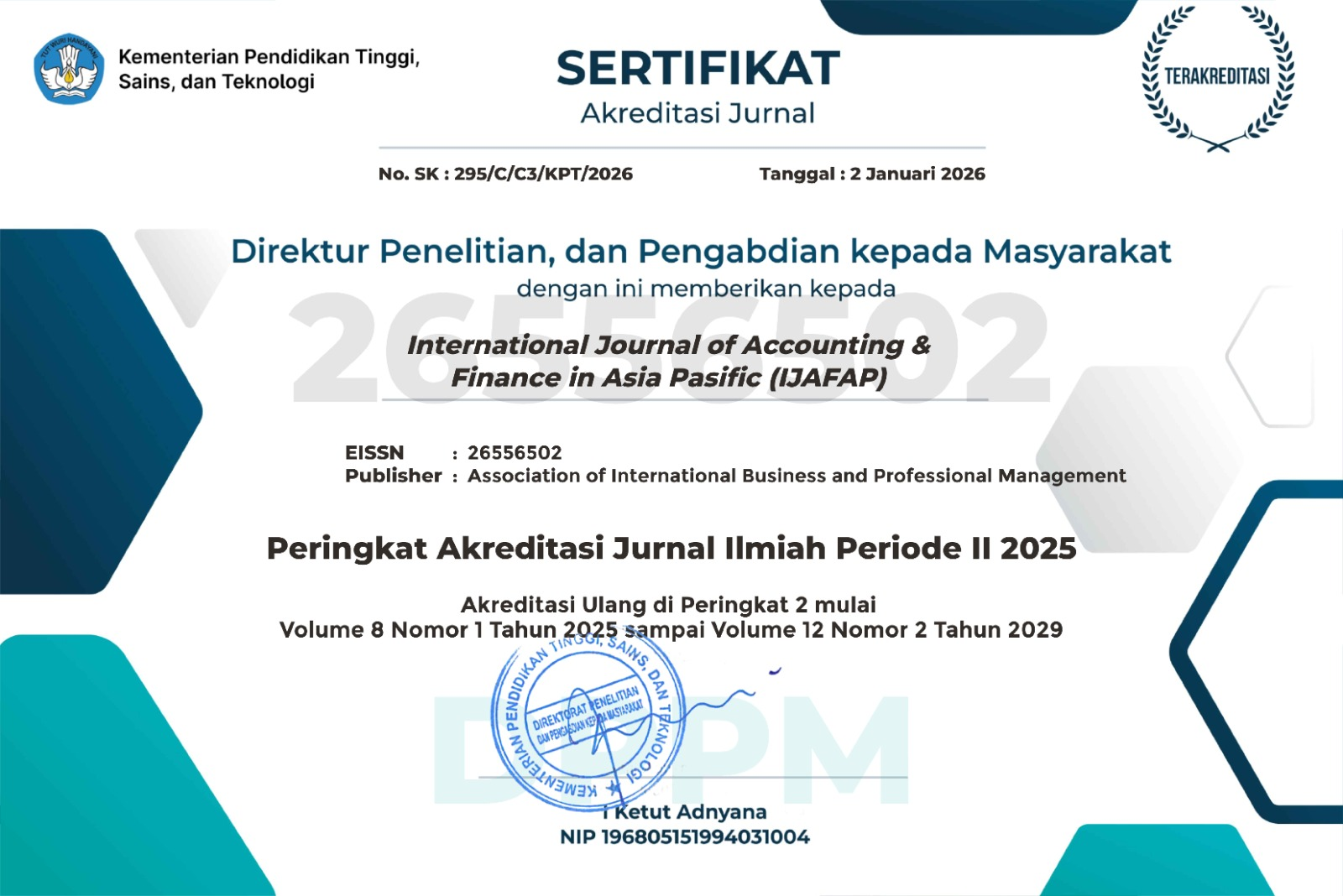
International Journal of Accounting and Finance in Asia Pacific (IJAFAP)
ISSN 2684-9763 (Print) | ISSN 2655-6502 (Online)
DOI Prefix: 10.32535 by CrossRef
Published by AIBPM Publisher
JL. Kawi No. 23, Bareng, Klojen, Kota Malang, Jawa Timur, Indonesia
Email: adm.ijafap@gmail.com
Phone: +62 896-8679-1980
Website: https://ejournal.aibpmjournals.com/index.php/IJAFAP
Governed by
Association of International Business and Professional Management
Email: admin@aibpm.org
Website: https://www.aibpm.org/
Indexed by








Licensing Information

International Journal of Accounting and Finance in Asia Pacific (IJAFAP) is licensed under a Creative Commons Attribution-NonCommercial-ShareAlike 4.0 International License.