








Does Minimum Investment Capital Matter? Internal Locus of Control and Investment Interest among Generation Z
Abstract
The rapid growth of capital market investors in Indonesia has not been accompanied by a proportional increase in investment participation among Generation Z, particularly in Denpasar City. This study examines the effect of internal locus of control on investment interest, investigates the influence of perceived minimum investment capital, and analyzes its moderating role in the relationship between internal locus of control and investment interest. A quantitative research design was employed using a survey of 292 Generation Z respondents in Denpasar City selected through purposive sampling. Data were collected using a structured questionnaire and analyzed using Partial Least Squares–Structural Equation Modeling (PLS-SEM). The findings reveal that internal locus of control and perceived minimum investment capital have a positive and significant effect on investment interest (b = 0.349, p < 0.001; b = 0.522, p < 0.001), and perceived minimum investment capital positively moderates the relationship between internal locus of control and investment interest (b = 0.045, p = 0.002). The study extends the application of the Theory of Planned Behavior (TPB) by demonstrating that the interaction between psychological factors and perceived financial accessibility influences investment interest. In practice, the findings suggest that investment participation among Generation Z can be enhanced through affordable investment entry requirements.
Keywords
Full Text:
PDFReferences
Adibroto, A. S. (2023). Pengaruh Literasi Keuangan, Modal Minimal, Persepsi Risiko, Social Media Influencer, dan Kemajuan Teknologi Terhadap Minat Investasi Mahasiswa Akuntansi di Pasar Modal [Undergraduate thesis, Universitas Islam Indonesia]. Dspace UII. https://dspace.uii.ac.id/handle/123456789/42297
Ajzen, I. (1991). The theory of planned behavior. Organizational Behavior and Human Decision Processes, 50(2), 179–211. https://doi.org/10.1016/0749-5978(91)90020-T
Amrul, R., & Wardah, S. (2020). Pengaruh modal minimal, pengetahuan investasi, dan motivasi terhadap minat berinvestasi mahasiswa di pasar modal. Jurnal Bisnis, Manajemen, dan Akuntansi, 7(1), 55–68.
Anjellah, R., & Umah, K. A. (2024). Analisis pengaruh locus of control dan financial literacy terhadap minat investasi di lembaga keuangan syariah. Al-Musthofa: Journal of Sharia Economics, 7(1), 32–50. https://doi.org/10.58518/al-musthofa.v7i1.2757
Ariyani, L. L., & Astuti, C. D. (2024). Pengaruh financial attitudes, risk perception, dan locus of control terhadap investment intention pada Generasi Milenial. Kompak: Jurnal Ilmiah Komputerisasi Akuntansi, 17(2), 150–166. https://doi.org/10.51903/kompak.v17i2.2045
Badan Pusat Statistik (BPS). (2020). Jumlah Penduduk menurut Wilayah, Klasifikasi Generasi, dan Jenis Kelamin, Indonesia, 2020. Badan Pusat Statistik. https://sensus.bps.go.id/topik/tabular/sp2020/2/0/0
Bibit Team. (2022, November 29). Jumlah Investor Pasar Modal Tembus 10 Juta, Reksa Dana Paling Banyak. Bibit: Artikel Investasi Reksadana dan SBN. https://blog.bibit.id/blog-1/jumlah-investor-pasar-modal-tembus-10-juta-reksa-dana-paling-banyak
Fauzianti, A., & Retnosari, R. (2022). Pengaruh modal awal investasi, pengetahuan investasi, sosial media influencer terhadap minat investasi mahasiswa akuntansi Universitas Tidar [The Effect of Initial Investment Capital, Investment Knowledge, Social Media Influencers on Investment Interest of Tidar University Accounting Students]. Jurnal Sinar Manajemen, 9(1), 26–35. https://doi.org/10.56338/jsm.v9i1.2323
Firmansyah, F. F., Sriyono, S., & Prapanca, D. (2024). Peran social media influencer, pengetahuan investasi, return investasi dan uang saku terhadap minat investasi pada Generasi Z di Kabupaten Sidoarjo. Jurnal Ilmiah Manajemen, Ekonomi, & Akuntansi, 8(1), 770–790. https://doi.org/10.31955/mea.v8i1.3763
Fishbein, M., & Ajzen, I. (1975). Belief, attitude, intention and behaviour: An introduction to theory and research. Philosophy and Rhetoric, 10(2), 130–132.
Guiso, L., Haliassos, M., & Jappelli, T. (2003). Household stockholding in Europe: Where do we stand and where do we go? Economic Policy, 18(36), 123–170. https://doi.org/10.1111/1468-0327.00104
Hagger, M. S., Cheung, M. W.-L., Ajzen, I., & Hamilton, K. (2022). Perceived behavioral control moderating effects in the theory of planned behavior: A meta-analysis. Health Psychology, 41(2), 155–167. https://doi.org/10.1037/hea0001153
Hair, J. F., Hult, G. T. M., Ringle, C. M., Sarstedt, M., Danks, N. P., & Ray, S. (2021). Partial Least Squares Structural Equation Modeling (PLS-SEM) Using R: A Workbook (1st ed.). Springer International Publishing. https://doi.org/10.1007/978-3-030-80519-7
Hendrayanti, S., & Shavira, P. D. (2023). The influence of minimum capital, investment knowledge and investment risk perception on student investment interest in the capital market. Jurnal Capital: Kebijakan Ekonomi, Manajemen dan Akuntansi, 5(1), 117–134. https://doi.org/10.33747/capital.v5i1.186
Hidayanti, S. M., Tampubolon, L. H., & Prasadja, H. (2024). Pengaruh minimal modal investasi terhadap minat investasi Reksadana pada mahasiswa Gen Z di Jabodetabek. Journal of Social and Economics Research, 6(1), 1537–1550. https://doi.org/10.54783/jser.v6i1.484
Isaac, S., & Michael, W. B. (1981). Handbook in Research and Evaluation. EdITS Publishers.
Junaeni, I. (2020). Analysis of factors that influence decision making invest in capital markets in Millennial Generations. International Journal of Accounting & Finance in Asia Pasific, 3(3), 11–24. https://doi.org/10.32535/ijafap.v3i3.866
Kong, D., Cheng, Y., & Liu, S. (2021). Unexpected housing wealth appreciation and stock market participation. Journal of Housing Economics, 52, 101768. https://doi.org/10.1016/j.jhe.2021.101768
Masridha, M., Syahprya, W. D., & Nasution, Y. S. J. (2023). Meningkatnya jumlah investor dalam pasar saham Indonesia pada era pandemi Covid-19. Maeswara: Jurnal Riset Ilmu Manajemen dan Kewirausahaan, 1(4), 48–57. https://doi.org/10.61132/maeswara.v1i4.63
Maulida, D., & Pospos, A. F. F. (2021). Pengaruh pengetahuan, motivasi dan modal minimum terhadap minat berinvestasi. Jurnal Investasi Islam, 6(1), 22–41. https://doi.org/10.32505/jii.v6i1.3019
Onasie, V., & Widoatmodjo, S. (2020). Niat investasi Generasi Milenial di pasar modal. Jurnal Manajerial dan Kewirausahaan, 2(2), 318. https://doi.org/10.24912/jmk.v2i2.7924
Putri, L. P., Christiana, I., Pulungan, D. R., & Ardila, I. (2019). Investment literation improvement for preparation of investments for young investors. International Journal of Accounting & Finance in Asia Pasific, 2(3), 32–40. https://doi.org/10.32535/ijafap.v2i3.587
Salamanca, N., Grip, A. D., Fouarge, D., & Montizaan, R. (2020). Locus of control and investment in risky assets. Journal of Economic Behavior & Organization, 177, 548–568. https://doi.org/10.1016/j.jebo.2020.06.032
Saputra, E. Z., & Purba, D. (2021). Pengaruh motivasi dan modal minimal terhadap minat investasi saham mahasiswa di Batam. Scientia Journal: Jurnal Ilmiah Mahasiswa, 3(3), 1–10.
Sari, V. M., Putri, N. K., Arofah, T., & Suparlinah, I. (2021). Pengaruh motivasi investasi, pengetahuan dasar investasi, modal minimal, dan kemajuan teknologi terhadap minat investasi mahasiswa. Jurnal Doktor Manajemen, 4(1), 88–107. https://doi.org/10.22441/jdm.v4i1.12117
Sengge, A. (2024, May 10). Pertumbuhan Ekonomi NTT Terendah di Kawasan Bali-NTB. Indonesia. Radio Republik Indonesia. https://rri.co.id/kupang/regional/683402/pertumbuhan-ekonomi-ntt-terendah-di-kawasan-bali-ntb
Setianingsih, D., Dewi, M., & Chanda, A. (2022). The effect of financial knowledge, financial planning, internal locus of control, and financial self-efficacy on financial management behaviour: A case study of SMEs Grocery Stores. Jurnal Samudra Ekonomika, 6(1), 19–30. https://doi.org/10.33059/jse.v6i1.5068
Sitorus, M. R. U., & Adlina, H. (2024). Pengaruh financial knowledge dan internal locus of control terhadap personal financial management behavior (Studi pada pelaku UMKM di Jalan STM Kota Medan). Jurnal Ilmiah Wahana Pendidikan, 10(22), 826–838. https://doi.org/10.5281/zenodo.14576427
Sugiyono, S. (2025). Metode Penelitian Kuantitatif, Kualitatif, dan R&D – MPKK (7th ed.). Alfabeta.
Teoh, K. B., Pérez-Restrepo, C., López, C. A., Thulasedass, S., S, C., Chetana, S., Singh, P., ..., & Das, A. (2021). A study on investors’ perceptions towards stock market. International Journal of Accounting & Finance in Asia Pasific, 4(3), 60–74. https://doi.org/10.32535/ijafap.v4i3.1206
Wahyuningtias, P. A., Pakaya, A. R., & Selvi, S. (2024). Pengaruh modal minimal dan pemahaman investasi terhadap minat mahasiswa berinvestasi saham di pasar modal (Studi kasus mahasiswa FE Universitas Negeri Gorontalo). Jambura: Jurnal Ilmiah Manajemen dan Bisnis, 6(3), 1378–1390. https://doi.org/10.37479/jimb.v6i3.23339
Widhiastuti, R. N., & Novianda, B. F. (2024). Pengaruh literasi keuangan, pengetahuan investasi, dan motivasi terhadap minat investasi Generasi Z di Jabodetabek. Kompleksitas: Jurnal Ilmiah Manajemen, Organisasi dan Bisnis, 13(1), 84–93. https://doi.org/10.56486/kompleksitas.vol13no1.527
Widiastiti, D. A. D., & Yudantara, I. G. A. P. (2023). Pengaruh modal minimal, ekspektasi return, kemajuan teknologi, dan peran social media influencer terhadap minat investasi saham pada kalangan Generasi Z di Kota Denpasar. Jurnal Akuntansi Profesi, 14(2), 430–441. https://doi.org/10.23887/jap.v14i02.65072
Wilda, J., Amelia, A., & Sartika, F. (2025). Pengaruh literasi keuangan dan locus of control terhadap minat berinvestasi mahasiswa Prodi Manajemen Fakultas Ekonomi Universitas Muhammadiyah Aceh. Jurnal Mirai Management, 10(1), 1–12. https://doi.org/10.37531/mirai.v10i1.8191
Wulandari, W. (2006). Hubungan Locus of Control dengan Prokrastinasi Akademik Mahasiswa Program Studi Bimbingan dan Konseling [Undergraduate thesis, Universitas Kristen Satya Wacana]. UKWS.
DOI: https://doi.org/10.32535/ijafap.v9i3.4823
Refbacks
- There are currently no refbacks.
Copyright (c) 2026 Ni Made Indah Mentari, Tiara Carina, Ni Luh Gede Putu Purnawati

This work is licensed under a Creative Commons Attribution-NonCommercial-ShareAlike 4.0 International License.
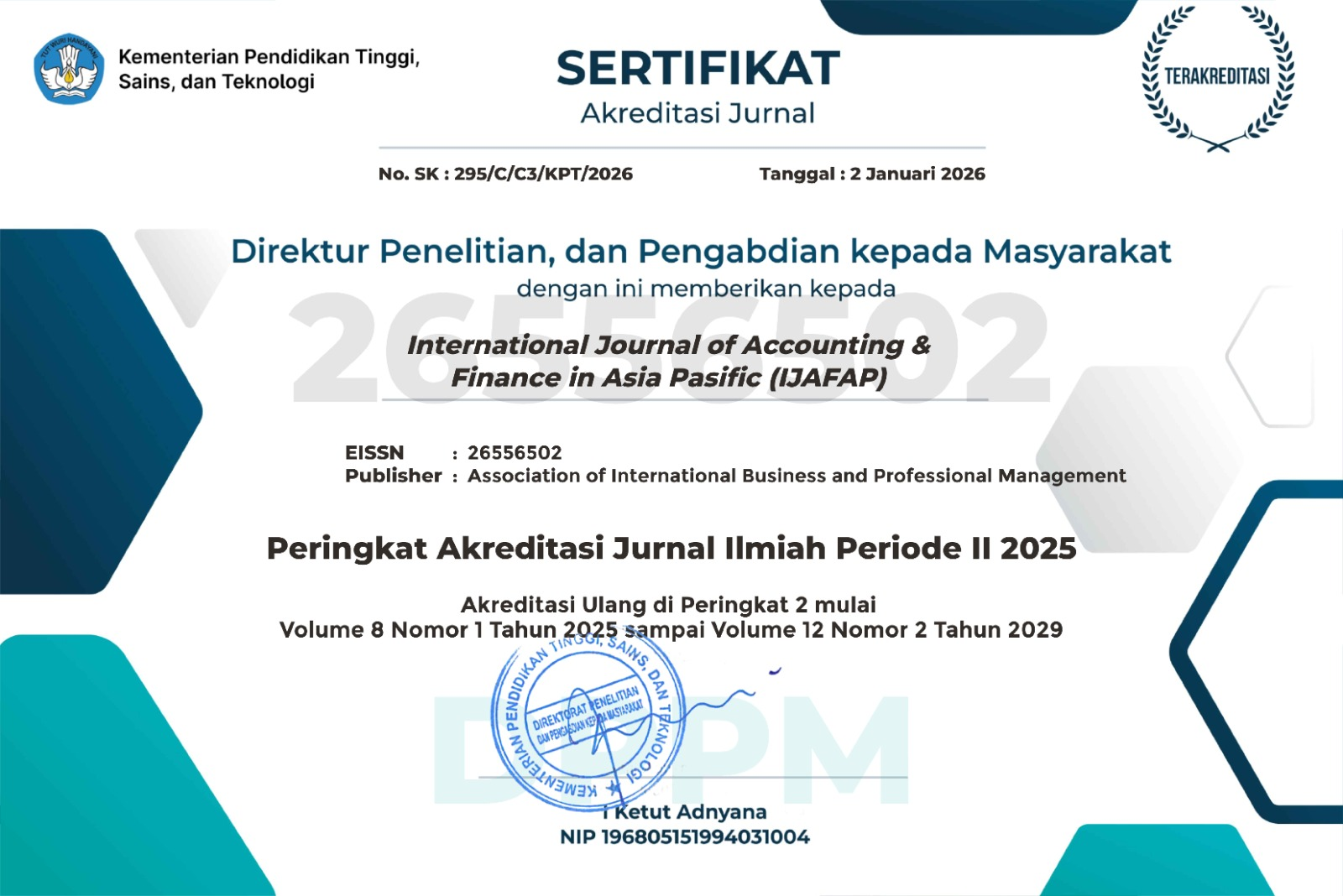
International Journal of Accounting and Finance in Asia Pacific (IJAFAP)
ISSN 2684-9763 (Print) | ISSN 2655-6502 (Online)
DOI Prefix: 10.32535 by CrossRef
Published by AIBPM Publisher
JL. Kawi No. 23, Bareng, Klojen, Kota Malang, Jawa Timur, Indonesia
Email: adm.ijafap@gmail.com
Phone: +62 896-8679-1980
Website: https://ejournal.aibpmjournals.com/index.php/IJAFAP
Governed by
Association of International Business and Professional Management
Email: admin@aibpm.org
Website: https://www.aibpm.org/
Indexed by








Licensing Information

International Journal of Accounting and Finance in Asia Pacific (IJAFAP) is licensed under a Creative Commons Attribution-NonCommercial-ShareAlike 4.0 International License.