





 Email this article
 Teachers’ Perceptions of Ethical Social Media Use for Senior High School Students in West Java
Abstract
As social media becomes more common in schools, it is important to be aware of ethics in order to encourage responsible digital behavior. This study seeks to investigate teachers' perceptions of digital ethics regarding social media usage among senior high school students in West Java. A quantitative survey design was utilized, encompassing 360 Religious and Character Education teachers chosen via multistage random sampling. A 33-item questionnaire was used to collect data on seven aspects of digital ethics. The answers were measured on a 5-point Likert scale. The results show that there is a high level of agreement on all dimensions (mean range: 4.13–4.51), which means that people really understand digital ethics. Justice and equality (M = 4.51) and respect for human rights (M = 4.51) were the most highly rated dimensions. Ethical data practices (M = 4.27) got the lowest score. There were only small differences between demographic groups. These results show how important it is to include digital ethics in school curricula, especially in areas that are not as well-known, like data ethics and sustainability, to help students become better digital citizens.
Keywords
Full Text:
PDFReferences
Adawiyah, R. (2023). Management of religious character education in the digital era: The role of schools and parents’ collaboration. KnE Social Sciences, 8(16), 330–344. https://doi.org/10.18502/kss.v8i16.14052
Amriani, A., Maftuh, B., Nurdin, E. S., & Safei, M. (2023). Ethics of using technology in strengthening students religious character. Al-Hayat: Journal of Islamic Education, 7(2), 488–505. https://doi.org/10.35723/ajie.v7i2.362
Andries, F., & Lengkoan, F. (2023). The importance of students’ perception of online learning during pandemic. International Journal of Applied Business and International Management, 8(2), 294–305. https://doi.org/10.32535/ijabim.v8i2.2475
Ardiputra, S., Burhanuddin, B., AR, M. Y., Maulana, M. I., & Pahruddin, P. (2022). Sosialisasi UU ITE No. 19 Tahun 2016 dan edukasi cerdas dan bijak dalam bermedia sosial. Jurnal Abdi Masyarakat Indonesia, 2(2), 707–718. https://doi.org/10.54082/jamsi.314
Arif, A. M., & Elya, E. (2021). Character education based on religious values: The case of elementary schools in Palu, Indonesia. International Journal of Education, Learning and Development, 9(8), 54–70. https://doi.org/10.37745/ijeld.2013
Arnold, M., Goldschmitt, M., & Rigotti, T. (2023). Dealing with information overload: A comprehensive review. Frontiers in Psychology, 14, 1122200. https://doi.org/10.3389/fpsyg.2023.1122200
Association for Learning Technology (ALT). (2021). ALT’s Framework for Ethical Learning Technology. ALT. https://www.alt.ac.uk/alts-framework-ethical-learning-technology
Baccarella, C. V, Wagner, T. F., Kietzmann, J. H., & McCarthy, I. P. (2018). Social media? It’s serious! Understanding the dark side of social media. European Management Journal, 36(4), 431–438. https://doi.org/10.1016/j.emj.2018.07.002
Borualogo, I. S., & Casas, F. (2023). Sibling bullying, school bullying, and children’s subjective well-being before and during the COVID-19 Pandemic in Indonesia. Child Indicators Research, 16(3), 1203–1232. https://doi.org/10.1007/s12187-023-10013-5
Deviv, S., Asri, A., & Lawa, F. R. (2024). Social media utilisation and its implications for students ethics in higher education. Journal of Indonesian Scholars for Social Research, 4(1), 7–11. https://doi.org/10.59065/jissr.v4i1.126
Ghosh, R., Malhotra, M., & Kumar, N. (2025). Cyber bullying in the digital age: challenges, impact, and strategies for prevention. In Combating Cyberbullying with Generative AI (pp. 151-180). IGI Global Scientific Publishing. https://doi.org/10.4018/979-8-3373-0543-1.ch006
Haleem, A., Javaid, M., Qadri, M. A., & Suman, R. (2022). Understanding the role of digital technologies in education: A review. Sustainable Operations and Computers, 3, 275–285. https://doi.org/10.1016/j.susoc.2022.05.004
Indriani, M. N., Ayu, I. G., Pramesti, A., Gunawan, J., Lee, J. C., Rozario, S. P., & Tian, C. (2024). Riding the waves of change: The future of education 2030 and beyond. Asia Pacific Journal of Management and Education, 7(2), 29–42. https://doi.org/10.32535/apjme.v7i2.3244
Microsoft Source. (2020). Civility, Safety & Interaction Online. Microsoft Source. https://news.microsoft.com/wp-content/uploads/prod/sites/421/2020/02/Digital-Civility-2020-Global-Report.pdf
Muhammadiah, M., Hamsiah, A., Muzakki, A., Nuramila, N., & Fauzi, Z. (2022). The role of the professional teacher as the agent of change for students. AL-ISHLAH: Jurnal Pendidikan, 14(4), 6887–6896. https://doi.org/10.35445/alishlah.v14i4.1372
Novella-García, C., & Cloquell-Lozano, A. (2021). The ethical dimension of digital competence in teacher training. Education and Information Technologies, 26(3), 3529–3541. https://doi.org/10.1007/s10639-021-10436-z
Nugroho, E. W., & Widiantoro, A. D. (2025). Teacher digital literacy based on the pillars of skill, ethics, safety, and culture. Journal of Sustainable Communities and Development, 3(2), 39–48. https://doi.org/10.63158/SCD.v3i1.39
Organisation for Economic Co-operation and Development (OECD). (2022). PISA 2022 Result. OECD. https://www.oecd.org/content/dam/oecd/en/publications/reports/2023/11/pisa-2022-results-volume-i-and-ii-country- notes_2fca04b9/indonesia_0e09c072/c2e1ae0e-en.pdf
Özer, N., & ?ad, S. N. (2021). Cyberbullying, cybervictimization, and school burnout among high school students. Milli E?itim Dergisi, 50(229), 393-417.
Purbiyati, Y. S., & Andrew, R. (2025). The moderating role of digital transformation on the influence of workplace spirituality and sustainable leadership on school organizational performance. International Journal of Applied Business and International Management, 10(3), 445–463. https://doi.org/10.32535/ijabim.v10i3.4237
Rahmatunnisa, M. (2024). Learning lessons for Indonesia regarding the empowerment of women through digital literacy. E-Journal of Media & Society, 7(3), 24–48.
Rayhan, Y., Handarkho, Y. D., & Setyohadi, D. B. (2025). Analysis of factors influencing intention to use financial technology Peer-to-Peer (P2P) lending. Journal of Financial Economics & Investment, 5(3), 190–206. https://doi.org/10.22219/jofei.v5i3.42111
Robertson, J., Ferreira, C., Watson, R. T., McCarthy, I., Kietzmann, J., & Pitt, L. (2024). Assessing digital responsibility in a digital-first world: Revisiting the u-commerce framework. Organizational Dynamics, 53(2), 101044. https://doi.org/10.1016/j.orgdyn.2024.101044
Rodriguez, C. A., Gopalakrishnan, L., Cid, M. Del, Folk, J. B., Yonek, J., & Shams, M. T. (2021). The ethical implications of using social media to engage and retain justice-involved youth in behavioral health research. Journal of Empirical Research on Human Research Ethics, 16(4), 356–363. https://doi.org/10.1177/15562646211039701
Rogerson, S. (2021). The Evolving Landscape of Ethical Digital Technology. Taylor Francis.
Rolando, D. M., As’ad, M., Setiawati, R., & Fajri. (2024). Strengthening religious literacy as an effort to overcome the moral degradation of Generation Z in the digital era. 1st The First Annual International Conference on Social, Literacy, Art, History, Library, and Information Science, 72–92. https://doi.org/10.18502/kss.v9i12.15821
Sapdi, R. M. (2023). Peran guru dalam membangun pendidikan karakter di Era Society 5.0. Jurnal Basicedu, 7(1), 993–1001. https://doi.org/10.31004/basicedu.v7i1.4730
Tantakov, G., Maigeldiyeva, Z., Omarov, D., Seiitkazy, P., & Maigeldiyeva, S. (2025). The ethics and moral values in digital education: A cluster-based exploration of student perspectives. Journal of Culture and Values in Education, 8(3), 179–202. https://doi.org/10.46303/jcve.2025.28
Wiencierz, C., & Lünich, M. (2022). Trust in open data applications through transparency. New Media & Society, 24(8), 1751–1770. https://doi.org/10.1177/1461444820979708
Yuliantini, L. S., & Suswanta, S. (2024). The effectiveness analysis of the national digital literacy movement siberkreasi program in Indonesia. 1st International Graduate Conference on Digital Policy and Governance Sustainability (DiGeS-Grace 2024), 204. https://doi.org/10.1051/shsconf/202420403004
DOI: https://doi.org/10.32535/ijabim.v11i1.4474
Refbacks
- There are currently no refbacks.

Copyright (c) 2026 Rizal Kailani, Mohammad Ali, Laksmi Dewi

This work is licensed under a Creative Commons Attribution-NonCommercial-ShareAlike 4.0 International License.
International Journal of Applied Business and International Management (IJABIM)
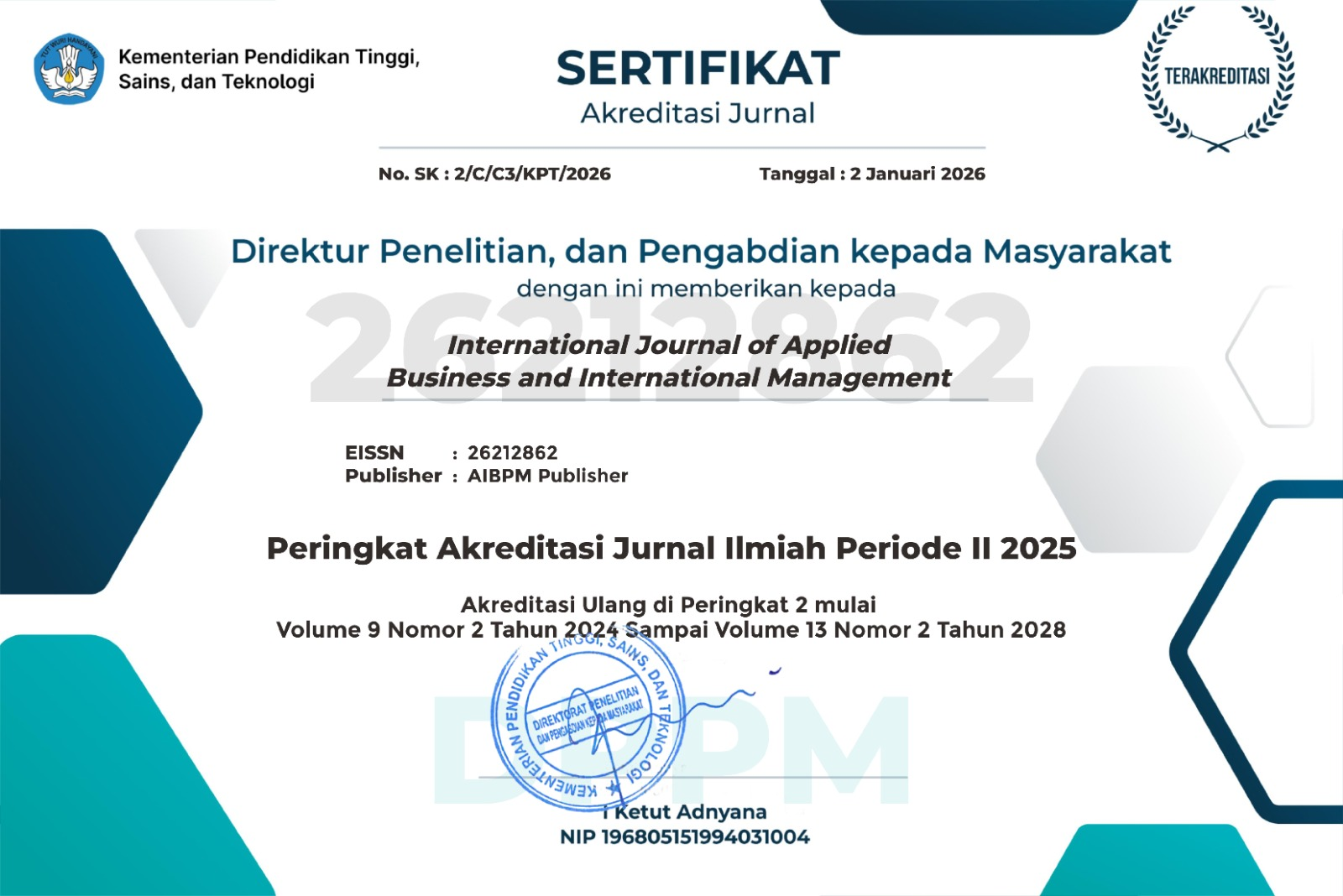
ISSN 2614-7432 (Print) | ISSN 2621-2862 (Online)
DOI Prefix: 10.32535 by CrossRef
Published by AIBPM Publisher
JL. Kawi No. 23, Bareng, Kec. Klojen, Kota Malang, Jawa Timur, Indonesia
Email: journal.ijabim@gmail.com
Phone: +62 341 366222
Website: https://aibpmpublisher.com/
Governed by
Association of International Business and Professional Management
Email: admin@aibpm.org
Website: https://www.aibpm.org/


Licensing Information

The International Journal of Applied Business and International Management (IJABIM) is licensed under a Creative Commons Attribution-NonCommercial-ShareAlike 4.0 International License .
Follow Us:

