





 Email this article
 A Systematic Literature Review on the Determinants of Community Welfare
Abstract
Issues of cognitive decline, family income, and caregiving responsibilities are increasingly integrated in the study of societal well-being. This systematic literature review aims to evaluate and synthesize research on the impact of income, a husband's cognitive decline, and family responsibilities on societal well-being. Using PRISMA, a systematic search in the Scopus database for articles published between January 2019 and April 2024 identified six articles that met the inclusion criteria. The synthesis results of these articles show that only the influence of income and welfare was found from a total of 882 articles. The results showed no relationship between the husband's cognitive decline and family responsibilities and community welfare; only the relationship between income and community welfare was found in this study. Apart from that, the results also show that most of the research was carried out in the economic, regional economic, forestry, and agricultural sectors. Furthermore, theories identified in the reviewed studies include income welfare theory, material welfare theory, Keynesian economic theory, Friedmann and Douglass’ theory, and political theory. These findings highlight the dominant role of income in community welfare, while indicating limited empirical attention to husbands’ cognitive decline and family responsibilities, underscoring the need for further research.
Keywords
Full Text:
PDFReferences
Akram, O., & Maîtrot, M. (2023). Family’s roles as a welfare pillar: The case of older persons living in extreme poverty in Bangladesh. Development Policy Review, 41(3), 1–19. https://doi.org/10.1111/dpr.12679
Anand, P., Jones, S., Donoghue, M., & Teitler, J. (2021). Non-monetary poverty and deprivation: A capability approach. Journal of European Social Policy, 31(1), 78–91. https://doi.org/10.1177/0958928720938334
Ayele, A. W., Ewinetu, Y., Delesho, A., Alemayehu, Y., & Edemealem, H. (2025). Prevalence and associated factors of multidimensional poverty among rural households in East Gojjam zone, Northern Ethiopia: A community-based cross-sectional study. BMC Public Health, 25(1), 1–17. https://doi.org/10.1186/s12889-025-21280-y
Bailusy, M. N., Buamonabot, I., Fahri, J., & Arilaha, M. A. (2022). Online shopping Indonesia: Customer perception. International Journal of Applied Business and International Management, 7(2), 82–104. https://doi.org/10.32535/ijabim.v7i2.1662
Caliskan, F., Idug, Y., Uvet, H., Gligor, N., & Kayaalp, A. (2024). Social comparison theory: A review and future directions. Psychology and Marketing, 41(11), 2823–2840. https://doi.org/10.1002/mar.22087
Cao, B., Zhu, H., Chen, Z., Song, Z., Huang, X., & Yu, B. (2023). Evaluating household welfare in participation of China’s natural forest protection program: A dual perspective of income welfare and material welfare. Forests, 14(6), 1140. https://doi.org/10.3390/f14061140
Choi, S. Y., & Seo, J. Y. (2019). Analysis of caregiver burden in palliative care: An integrated review. Nursing Forum, 54(2), 280–290. https://doi.org/10.1111/nuf.12328
Foggia, G. Di, Arrigo, U., & Beccarello, M. (2025). Evolution and theoretical implications of the utility concept. Economies, 13(10), 1–20. https://doi.org/10.3390/economies13100283
Gil-Hernández, C. J., Salas-Rojo, P., Vidal, G., & Villani, D. (2025). Wealth and income stratification by social class in five European countries. Social Indicators Research, 178(2), 817–841. https://doi.org/10.1007/s11205-025-03532-x
Goyal, K., & Kumar, S. (2021). Financial literacy: A systematic review and bibliometric analysis. International Journal of Consumer Studies, 45(1), 80–105. https://doi.org/10.1111/ijcs.12605
Hawkley, L., Zheng, B., Hedberg, E. C., Huisingh-Scheetz, M., & Waite, L. (2020). Cognitive limitations in older adults receiving care reduces well-being among spouse caregivers. Psychology and Aging, 35(1), 28–40. https://doi.org/10.1037/pag0000406
Kamal, M., Hasyim, A. W., Daud, N., & Sabuhari, R. (2025). The impact of empowerment leadership, social capital, and sustainability programs on long-term community welfare: A systematic literature review study. Society, 13(2), 1018–1036. https://doi.org/10.33019/society.v13i2.924
Kandel, P., Pandit, R., White, B., & Polyakov, M. (2022). Do protected areas increase household income? Evidence from a Meta-Analysis. World Development, 159, 106024. https://doi.org/10.1016/j.worlddev.2022.106024
Leggett, A. N., Choi, H. J., Chopik, W. J., Liu, H., & Gonzalez, R. (2020). Early cognitive decline and its impact on spouse’s loneliness. Research in Human Development, 17(1), 78–93. https://doi.org/10.1080/15427609.2020.1750293
Liang, Z. (2026). Macroeconomic theory: History and outlook. In The Innovation of Economic Theory in China (pp. 1–39). Palgrave Macmillan. https://doi.org/10.1007/978-981-95-2713-7_1
Madsen, M. O. (2025). Revisiting Keynes: Work, welfare, and the future of economic possibilities. Review of Political Economy, 1-13. https://doi.org/10.1080/09538259.2025.2554831
Martati, I., Asniwaty, B., & Suminto, S. (2020). The impact of regional income to welfare of regencies and cities community in East Kalimantan, Indonesia. Academy of Entrepreneurship Journal, 26(1), 1–10.
Martela, F. (2024). Being as having, loving, and doing: A theory of human well-being. Personality and Social Psychology Review, 28(4), 372–397. https://doi.org/10.1177/10888683241263634
Moncatar, T. R. T., Nakamura, K., Siongco, K. L. L., Seino, K., Carlson, R., Canila, C. ..., & Lorenzo, F. M. E. (2021). Interprofessional collaboration and barriers among health and social workers caring for older adults: A Philippine case study. Human Resources for Health, 19(1), 1–14. https://doi.org/10.1186/s12960-021-00568-1
Muhammad, N. I., Sirait, A. H., Ahmad, A. C., & Jabid, A. W. (2025). Business sustainability strategy: Systematic literature review. Society, 13(1), 705–727. https://doi.org/10.33019/society.v13i1.784
Muttaqin, A. A. (2022). Irrational choice of bankers: Wealth or welfare? International Journal of Accounting Finance in Asia Pasific, 5(1), 104–114. https://doi.org/10.32535/ijafap.v5i1.1410
Nasar, F., Sirat, A. H., Husen, A., & Hadady, H. (2025). Fintech and low-income communities: A systematic literature review. Society, 13(1), 818–835. https://doi.org/10.33019/society.v13i1.764
Osberg, L. (2023). Index of economic well-being. In Encyclopedia of Quality of Life and Well-Being Research (pp. 3436–3438). Springer International Publishing. https://doi.org/10.1007/978-3-031-17299-1_1403
Page, M. J., Moher, D., Bossuyt, P. M., Boutron, I., Hoffmann, T. C., Mulrow, C. D., …, & Mckenzie, J. E. (2021). PRISMA 2020 explanation and elaboration: Updated guidance and exemplars for reporting systematic reviews. The BMJ, 372, 1–36. https://doi.org/10.1136/bmj.n160
Purbadharmaja, I. B. P., Maryunani, M., Ananda, C. F., & Santoso, D. B. (2019). The implications of fiscal decentralization and budget governance on economic capacity and community welfare. Foresight, 21(2), 227–249. https://doi.org/10.1108/FS-05-2018-0052
Rafiki, A., Dana, L. P., & Ong Hai Liaw, J. (2026). Entrepreneurial behavior in family business: bibliometric – systematic literature reviews (B-SLR). Journal of Enterprising Communities, 20(1), 249–276. https://doi.org/10.1108/JEC-12-2023-0233
Roche, S., Mendes, P., Marston, G., Bielefeld, S., Peterie, M., Staines, Z., & Humpage, L. (2022). Examining the consequences of welfare conditionality: A case study of compulsory income management in the regional community of Ceduna, Australia. Social Policy and Society, 21(3), 369–384. https://doi.org/10.1017/S1474746421000063
Rokhman, H. (2023). The importance of community welfare in economic growth through government spending. International Journal of Accounting & Finance in Asia Pacific, 6(3), 50–66. https://doi.org/10.32535/ijafap.v6i3.1893
Sinolungan, A. Y., & Kimbal, R. W. (2024). Factors influencing income of micro and small enterprises in Minahasa Regency. International Journal of Applied Business and International Management, 9(2), 80–95. https://doi.org/10.32535/ijabim.v9i2.2916
Stefansdottir, O. A., Munkejord, M. C., & Sudmann, T. (2024). Lost in transition: Community-dwelling partners’ stories of losing a spouse to cognitive decline and long-term care facilities. Gerontology and Geriatric Medicine, 10, 1–9. https://doi.org/10.1177/23337214241257838
Strakosch, E., Lahn, J., & Sullivan, P. (2024). Australian Indigenous policy at the intersection of bureaucracy, colonialism, neoliberalism and race (pp. 23–44). https://doi.org/10.1007/978-3-031-67733-5_2
Sun, S., & Geng, Y. (2022). Livelihood resilience and its influencing factors of worker households in the face of state-owned forest areas reform in China. Sustainability, 14(3), 1328. https://doi.org/10.3390/su14031328
Syahza, A., & Asmit, B. (2020). Development of palm oil sector and future challenge in Riau Province, Indonesia. Journal of Science and Technology Policy Management, 11(2), 149–170. https://doi.org/10.1108/JSTPM-07-2018-0073
Syahza, A., Tampubolon, D., Irianti, M., Meiwanda, G., & Asmit, B. (2023). The impact of small-scale oil palm plantation development on the economy multiplier effect and rural communities welfare. International Journal of Sustainable Development and Planning, 18(5), 1407–1415. https://doi.org/10.18280/ijsdp.180511
Watema, J. R. A., Siele, R. K., & Kimitei, E. (2025). Non-farm income and household welfare: Empirical evidence from a developing economy. Wellbeing, Space and Society, 8, 100232. https://doi.org/10.1016/j.wss.2024.100232
Weber, L., Maher, S., & Newitt, R. (2024). Bordered welfare in Australia: Income management as a bordering technology of neoliberal and colonial governance. Punishment and Society, 27(1), 68-90. https://doi.org/10.1177/14624745241251590
Wilcock, S. (2023). Policing Welfare Fraud: The Government of Welfare Fraud and Non-Compliance (1st ed.). Routledge. https://doi.org/10.4324/9780429277306
Xue, R., Faye, B., Zhang, R., Gong, X., & Du, G. (2024). Farmers’ willingness to engage in ecological compensation for crop rotation in China’s black soil regions. Agriculture, 14(8), 1320. https://doi.org/10.3390/agriculture14081320
Yuli, S. B. C., Septiani, E., Pramuja, R. A., Supiandi, S., & Najmudin, M. (2023). Tourism development and local community welfare: A case study of the Mandalika special economic zone. Journal of Environmental Management and Tourism, 14(4), 2097. https://doi.org/10.14505/jemt.v14.4(68).21
Zhang, S., Madni, G. R., & Yasin, I. (2022). Exploring the mutual nexus of social capital, social innovations and organizational performance. Sustainability, 14(19), 11858. https://doi.org/10.3390/su141911858
Zhang, Q. (2023). Elements: A case study of Tangqi. In The Elemental Metropolis: The Past and Future of the Extended Urbanity in the Yangtze River Delta, China (pp. 51-112). Springer Nature. https://doi.org/10.1007/978-3-031-36409-9_3
Zhu, W., Cao, Z., Luo, P., Tang, Z., Zhang, Y., Hu, M., & He, B. (2022). Urban flood-related remote sensing: Research trends, gaps and opportunities. Remote Sensing, 14(21), 1–16. https://doi.org/10.3390/rs14215505
DOI: https://doi.org/10.32535/ijabim.v11i1.4476
Refbacks
- There are currently no refbacks.

Copyright (c) 2026 Muhsin N. Bailusy, Abdul Hadi Sirat, Hartaty Hadady, Ida Hidayanti

This work is licensed under a Creative Commons Attribution-NonCommercial-ShareAlike 4.0 International License.
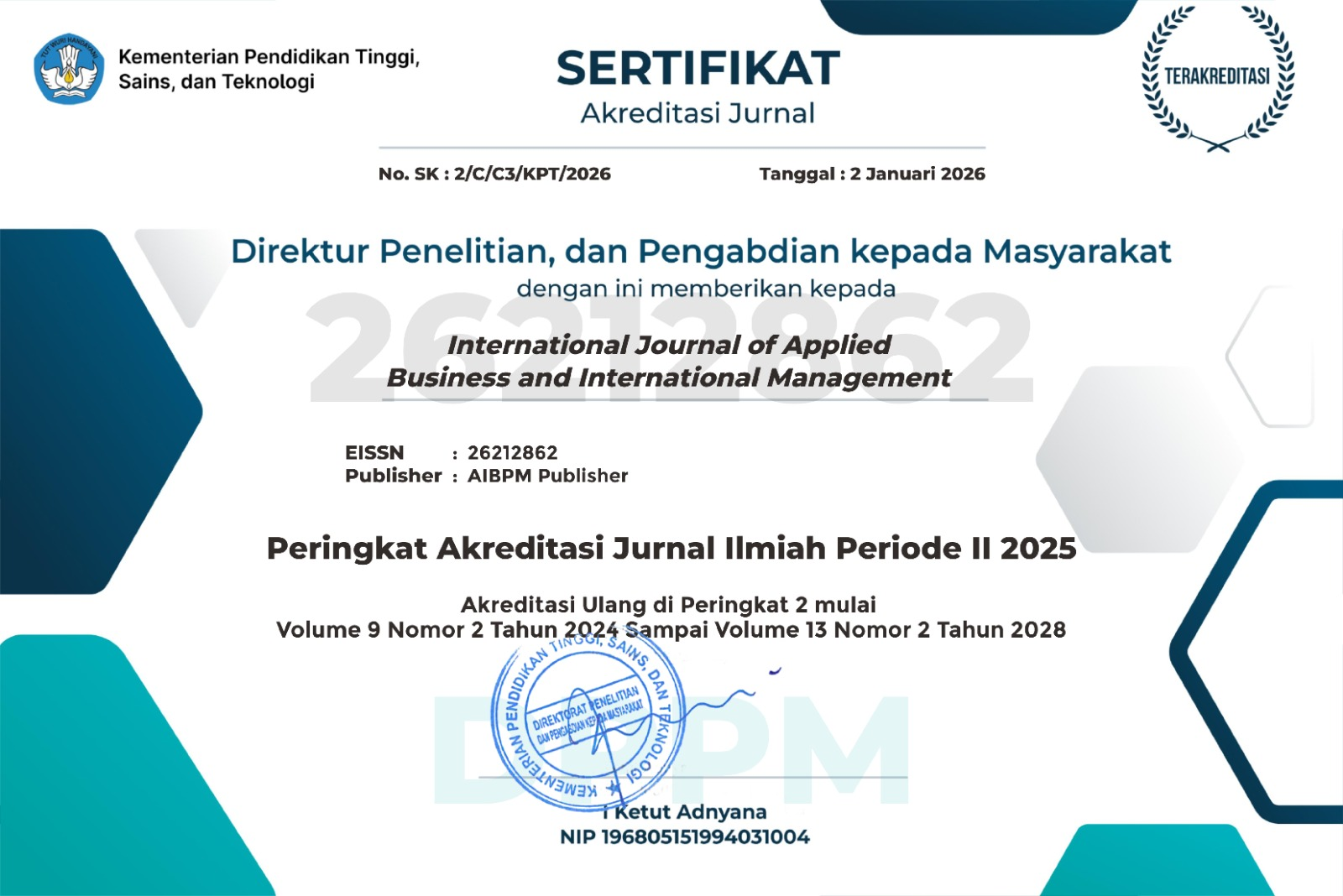
International Journal of Applied Business and International Management (IJABIM)
ISSN 2614-7432 (Print) | ISSN 2621-2862 (Online)
DOI Prefix: 10.32535 by CrossRef
Published by AIBPM Publisher
JL. Kawi No. 23, Bareng, Kec. Klojen, Kota Malang, Jawa Timur, Indonesia
Email: journal.ijabim@gmail.com
Phone: +62 341 366222
Website: https://aibpmpublisher.com/
Governed by
Association of International Business and Professional Management
Email: admin@aibpm.org
Website: https://www.aibpm.org/


Licensing Information

The International Journal of Applied Business and International Management (IJABIM) is licensed under a Creative Commons Attribution-NonCommercial-ShareAlike 4.0 International License .
Follow Us:

