





 Email this article
 The Internalization of Islamic Spiritual Values in Audit Practices: A Study on Auditor Independence
Abstract
This study examines how Islamic spiritual values are internalized in shaping auditor independence within financial audit practices, particularly in situations involving ethical tension and client pressure. While prior research has largely emphasized regulatory and structural determinants of independence, limited attention has been given to the internal cognitive and ethical processes that guide auditors’ decisions. This study aims to explore how such values are interpreted and enacted in practice. Using a qualitative phenomenological approach, data were collected through in-depth interviews with Muslim auditors from public accounting firms and were analyzed thematically. The findings reveal that four core values: shiddiq (truthfulness), amanah (responsibility), ‘adl (justice), and istiqomah (steadfastness), are internalized through reflective self-regulation and faith-based accountability, which function as intrinsic mechanisms reinforcing objectivity. Auditors consistently described resisting client pressure, maintaining evidence-based judgment, and prioritizing ethical consistency as manifestations of these values. The study concludes that auditor independence is not solely a function of external regulation but is significantly strengthened by the internalization of spiritual values, suggesting the importance of integrating value-based ethical development into professional training.
Keywords
Full Text:
PDFReferences
Anis, A. (2025). Auditing ethics education, moral intensity, and accounting students’ ethical decision-making: an experimental study. Accounting Education, 1-34. https://doi.org/10.1080/09639284.2025.2547623
Anwar, P. H. (2024). Audit dynamics of tenure and client pressure: An auditor independence study. Journal of Accounting and Digital Finance, 4(1), 58-68. https://doi.org/10.53088/jadfi.v4i1.1151
Ayedh, A. M., & Fatima, A. H. (2022). Audit quality framework’s input factors: An Islamic perspective. Al-Hikmah: International Journal of Islamic Studies and Human Sciences, 5(2), 62-88. https://doi.org/10.46722/hikmah.v5i2.250
Azim, M. I., & Islam, M. A. (2022). Auditor’s Independence in different countries. Khulna University Studies, 363–370. https://doi.org/10.53808/kus.2000.2.2.0058-l
Choi, J. (2026). Business strategy, audit risk, and auditor–client disagreement: Evidence from Korea. Risks, 14(3), 67. https://doi.org/10.3390/risks14030067
Colette, A. E., & Lukman, H. (2024). The influence of competence, independence, and auditor’s professional ethics on audit quality. International Journal of Application on Economics and Business, 2(1), 3007-3015. https://doi.org/10.24912/ijaeb.v2i1.3007-3015
Edgina, I. M. (2023). Pentingnya etika Islam pada profesi akuntan. Jurnal Akuntansi dan Bisnis Krisnadwipayana, 10(1), 1114-1123. https://doi.org/10.35137/jabk.v10i1.263
Fajrin, F. (2022). Pengaruh independensi, kecerdasan spiritual, dan ethical sensitivity terhadap kualitas audit pemerintah dengan integritas auditor sebagai variabel moderasi. Jurnal Ilmiah Akuntansi Peradaban, 8(2), 416-433. https://doi.org/10.24252/jiap.v8i2.34233
Hakiki, M. F., & Senjani, Y. P. (2022). The effect of workplace spirituality on audit quality with job satisfaction and organizational commitment as a mediation variable. ACCRUALS (Accounting Research Journal of Sutaatmadja), 6(01). https://doi.org/10.35310/accruals.v6i01.880
Hamid, A., Soewarno, N., & Isnalita, I. (2025). Auditor independence and threats: Mediating role of auditor ethics. AKRUAL: Jurnal Akuntansi, 17(1), 216-227. https://doi.org/10.26740/jaj.v17n1.p216-227
Hamrick, J., Schafer, J., & DeZoort, T. (2023). The effect of client gender and negotiation style on auditors' proposed audit adjustments. Advances in Accounting, 62, 100660. https://doi.org/10.1016/j.adiac.2023.100660
Harddian, R. (2022). Urgensi tauhid dalam indpendensi auditor. Jurnal Ekuivalensi, 8(2), 350-365. https://doi.org/10.51158/ekuivalensi.v8i2.900
Hartono, R., Widyastuty, T., Minrejo, S., & Pangaribuan, D. (2025). The influence of auditor independence, competence, and integrity on audit quality moderated by the auditor's code of professional ethics. Journal of Contemporary Accounting, 7(3), 184-194. https://doi.org/10.20885/jca.vol7.iss3.art3
Hermina, S. C., Kesuma, S. A., Nasution, F. N., & Erwin, K. (2026). A systematic literature review on ethics and artificial intelligence in the world of business and accounting (2024-2025). AKUA: Jurnal Akuntansi dan Keuangan, 5(1), 192-197. https://doi.org/10.54259/akua.v5i1.6006
Hwang, S., Sarath, B., & Han, S. Y. (2022). Auditor independence: The effect of auditors’ quality control efforts and corporate governance. Journal of International Accounting, Auditing and Taxation, 47, 100470. https://doi.org/10.1016/j.intaccaudtax.2022.100470
Khalid, A. A., & Sarea, A. M. (2021). Independence and effectiveness in internal Shariah audit with insights drawn from Islamic agency theory. International Journal of Law and Management, 63(3), 332-346. https://doi.org/10.1108/IJLMA-02-2020-0056
Kharisma, H., & Qintharah, Y. N. (2025). The effect of competence, moral reasoning, altruism, and auditor's locus of control behavior on audit quality. Jurnal Cendekia Keuangan, 4(2), 57-70. https://doi.org/10.32503/jck.v4i2.6767
Kumar, M. V. S. (2021). Auditors as prime stakeholders in corporate governance process. International Journal of Control and Automation, 12(4), 262-269.
Lubis, H. Z., & Siregar, N. P. (2025). The role of audit fees in moderating the impact of competency and professionalism on audit quality. Journal of International Conference Proceedings, 7(5), 1144-1154. https://doi.org/10.32535/jicp.v7i5.3796
Marisca, P., Septiano, R., Aryadi, D., Dona, E., & Heryanto, H. (2024). The role of professional ethics, independence, and work experience in auditor performance. Journal of International Conference Proceedings, 7(1), 284-297. https://doi.org/10.32535/jicp.v7i1.3094
Maulidi, A., Girindratama, M. W., Putra, A. R., Sari, R. P., & Nuswantara, D. A. (2024). Qualitatively beyond the ledger: Unravelling the interplay of organisational control, whistleblowing systems, fraud awareness, and religiosity. Cogent Social Sciences, 10(1), 2320743. https://doi.org/10.1080/23311886.2024.2320743
Pinatik, S. (2021). The effect of auditor's emotional intelligence, competence, and independence on audit quality. International Journal of Applied Business and International Management, 6(2), 55-67. https://doi.org/10.32535/ijabim.v6i2.1147
Purwantoro, P. (2025). Actualization of productivity and independence values in the hadith of the prophet: A thematic analysis of Islamic work ethics. Ats-Tsaqofi: Jurnal Pendidikan dan Manajemen Islam, 7(1), 1-15. https://doi.org/10.61181/ats-tsaqofi.v6i2.525
Rajest, S. S., & Regin, R. (2024). Examining the influence of religiosity and emotional intelligence on the ethical conduct and decision-making of auditors. American Journal of Economics and Business Management, 7(10), 852-862. https://doi.org/10.31150/ajebm.v7i10.2986
Ramadhani, M. I. N., Sari, F. R., & Juliardi, D. (2026). Auditor ethics as the foundation of audit quality: A systematic literature review. International Journal of Economics and Management Research, 5(1), 358-373. https://doi.org/10.55606/ijemr.v5i1.657
Safitry, S., Rosmanidar, E., Parawansha, A., Rahmawati, A., Sapitri, N., Devina, A., & Sari, K. P. (2025). Integrasi nilai Islam dalam audit: Telaah literatur terhadap etika dan penerapan maqashid syariah. ICONS: Islamic Economics Journal, 2(3), 134-148.
Sari, F. H., Jumliana, M., Kamal, N. A. A., Armalivia, S., & Cahyadi, R. (2025). The integrity of auditors in Islamic perspective a comparative study with the leadership of Umar Ibn Al-Khattab. Jurnal Ilmiah Akuntansi, Manajemen dan Ekonomi Islam, 8(3), 1466-1484. https://doi.org/10.36085/jamekis.v8i3.8819
Sari, N. R., & Juardi, M. S. S. (2025). Auditor independence through the lens of Islamic values: A phenomenological approach. Journal of Economic Education and Entrepreneurship Studies, 6(3), 292-306. https://doi.org/10.62794/je3s.v6i3.9400
Tjan, J. S., Muslim, M., Alimin, A., Noch, M. Y., & Sonjaya, Y. (2024). Independence, professional skepticism, and audit quality: The moderating role of audit fees. Jurnal Akuntansi, 28(1), 40-60. https://doi.org/10.24912/ja.v28i1.1698
Tormo-Carbó, G., Mardawi, Z., & Seguí-Mas, E. (2024). Should I stay or should I go? Auditor ethical conflict and turnover intention. Journal of Business Ethics, 194(2), 335-350. https://doi.org/10.1007/s10551-023-05583-x
Triwarti, H., & Putri, M. H. D. (2023). Pengaruh independensi, self-efficacy, etika profesi, dan audit tenure terhadap audit judgment dengan spiritual quotient sebagai variabel moderasi. AL-URBAN: Jurnal Ekonomi Syariah dan Filantropi Islam, 7(1), 16-28. https://doi.org/10.22236/alurban_vol7.i1/18664
Widyastuti, F. H., Saftiana, Y., & Yusnaini. (2025). Factors affecting the quality of internal audit: A systematic literature review. Journal of Finance and Business Digital, 4(3), 571-592. https://doi.org/10.55927/jfbd.v4i3.292
Wiratno, D. H., Krismiaji, K., Handayani, H., & Sumayyah, S. (2023). Financial distress, audit quality, and earnings management–Indonesia's mining sector evidence. Jurnal Maksipreneur: Manajemen, Koperasi, Dan Entrepreneurship, 12(2), 499-510. https://doi.org/10.30588/jmp.v12i2.1502
Wisesa, A. (2016). Cognitive moral development and its relevance in establishing moral integrity in organization. Sains Humanika, 8(1-2). https://doi.org/10.11113/sh.v8n1-2.832
Wu, B., Li, A., & Zhang, W. (2024). Clients' strategic change and auditor behavior: Evidence from audit adjustments and audit fees. Advances in Accounting, 64, 100721. https://doi.org/10.1016/j.adiac.2023.100721
Zhang, Y., & Wei, L. (2022). Philanthropy, audit firm culture, and auditor independence. Plos One, 17(11), e0277567. https://doi.org/10.1371/journal.pone.0277567
DOI: https://doi.org/10.32535/ijabim.v11i1.4527
Refbacks
- There are currently no refbacks.

Copyright (c) 2026 Yudhanta Sambharakreshna

This work is licensed under a Creative Commons Attribution-NonCommercial-ShareAlike 4.0 International License.
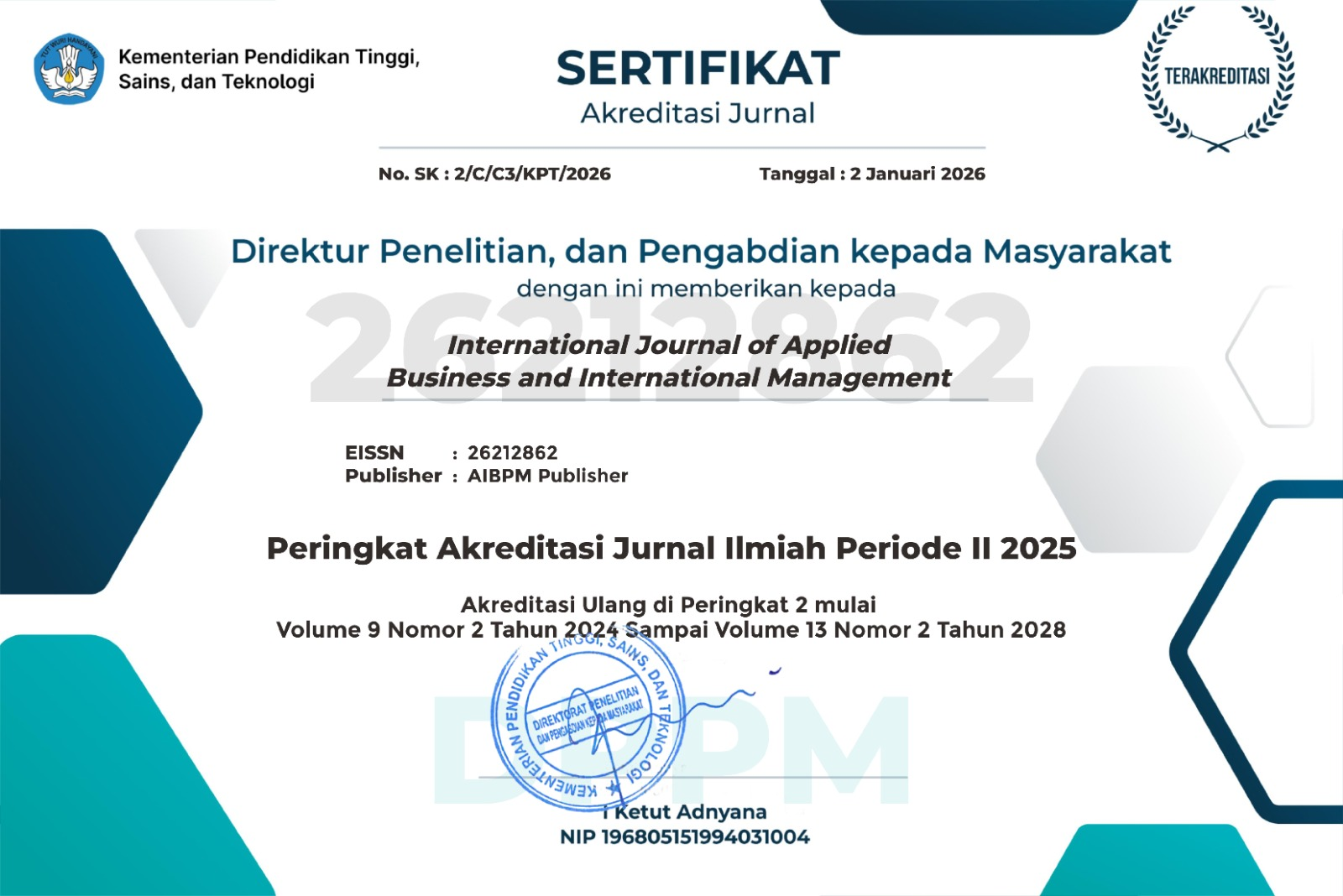
International Journal of Applied Business and International Management (IJABIM)
ISSN 2614-7432 (Print) | ISSN 2621-2862 (Online)
DOI Prefix: 10.32535 by CrossRef
Published by AIBPM Publisher
JL. Kawi No. 23, Bareng, Kec. Klojen, Kota Malang, Jawa Timur, Indonesia
Email: journal.ijabim@gmail.com
Phone: +62 341 366222
Website: https://aibpmpublisher.com/
Governed by
Association of International Business and Professional Management
Email: admin@aibpm.org
Website: https://www.aibpm.org/


Licensing Information

The International Journal of Applied Business and International Management (IJABIM) is licensed under a Creative Commons Attribution-NonCommercial-ShareAlike 4.0 International License .
Follow Us:

