





 Email this article
 Innovation Capability, Green Innovation, and Property Business Performance: Mediating Role of Competitive Advantage
Abstract
The property industry faces growing demands to integrate sustainability into business strategy. This study examines the effects of innovation capability and green innovation on business performance, mediated by competitive advantage, in the property industry of the Special Region of Yogyakarta (DIY). A quantitative explanatory design was applied, with landed housing projects as the unit of analysis. Data comprised 141 project-level responses covering 141 active landed housing projects, collected through a key informant approach and analyzed using Partial Least Squares Structural Equation Modeling (PLS-SEM). The results show that innovation capability significantly affects competitive advantage, while competitive advantage significantly affects business performance. Competitive advantage demonstrates indirect-only mediation (full mediation) between innovation capability and business performance. Green innovation, by contrast, does not significantly affect competitive advantage or business performance, either directly or through the mediating pathway. Innovation activities appear to function as integrative capabilities rather than separate practices. These findings confirm the Resource-Based View proposition that internal resources require conversion through competitive advantage. They also reveal the contextual limitations of applying the Natural Resource-Based View in regional property markets that remain price-sensitive and lack a mature green ecosystem.
Keywords
Full Text:
PDFReferences
Algieri, B. (2025). Competitive advantage and sustainability: Strategic perspectives for emerging markets. Journal of Business Research, 178, 114-128.
Awan, U., Sroufe, R., & Shahbaz, M. (2025). Green innovation and firm performance: A meta-analytic review. Business Strategy and the Environment, 34(2), 412-428.
Azizah, S., Putri, A. K., & Wahyudi, S. (2023). The role of competitive advantage in mediating innovation capability and business performance. Indonesian Journal of Business Studies, 12(3), 245-260.
Baird, K., Tung, A., & Su, S. (2024). The interactive effects of strategic orientations and competitive advantage on firm performance. Journal of Strategy and Management, 17(1), 89-107.
Barney, J. B. (1991). Firm resources and sustained competitive advantage. Journal of Management, 17(1), 99-120.
Barney, J. B., Ketchen, D. J., & Wright, M. (2021). Resource-based theory and the value creation framework. Journal of Management, 47(7), 1936-1955.
Cenamor, J., Parida, V., & Wincent, J. (2019). How entrepreneurial SMEs compete through digital platforms: The roles of digital platform capability, network capability and ambidexterity. Journal of Business Research, 100, 196-206.
Chen, Y. S., Lai, S. B., & Wen, C. T. (2006). The influence of green innovation performance on corporate advantage in Taiwan. Journal of Business Ethics, 67(4), 331-339.
Cheng, C. C. J., Yang, C. L., & Sheu, C. (2014). The link between eco-innovation and business performance: A Taiwanese industry context. Journal of Cleaner Production, 64, 81-90.
Coelho, R., Jayantilal, S., & Ferreira, J. J. (2023). The impact of social responsibility on corporate financial performance: A systematic literature review. Corporate Social Responsibility and Environmental Management, 30(4), 1535-1560.
DJKN Kemenkeu. (2024). Sertifikasi bangunan hijau di Indonesia: Implementasi dan tantangan. Direktorat Jenderal Kekayaan Negara, Kementerian Keuangan.
Fornell, C., & Larcker, D. F. (1981). Evaluating structural equation models with unobservable variables and measurement error. Journal of Marketing Research, 18(1), 39-50.
GBC Indonesia. (2024). Greenship-certified buildings in Indonesia. Green Building Council Indonesia.
Glick, W. H., Huber, G. P., Miller, C. C., Doty, D. H., & Sutcliffe, K. M. (1990). Studying changes in organizational design and effectiveness: Retrospective event histories and periodic assessments. Organization Science, 1(3), 293-312.
Hair, J. F., Hult, G. T. M., Ringle, C. M., Sarstedt, M., Danks, N. P., & Ray, S. (2021). Partial least squares structural equation modeling (PLS-SEM) using R: A workbook. Springer. https://doi.org/10.1007/978-3-030-80519-7
Hart, S. L. (1995). A natural-resource-based view of the firm. Academy of Management Review, 20(4), 986-1014.
Hart, S. L., & Dowell, G. (2011). A natural-resource-based view of the firm: Fifteen years after. Journal of Management, 37(5), 1464-1479.
Henseler, J., Ringle, C. M., & Sarstedt, M. (2015). A new criterion for assessing discriminant validity in variance-based structural equation modeling. Journal of the Academy of Marketing Science, 43(1), 115-135.
Homburg, C., Klarmann, M., Reimann, M., & Schilke, O. (2012). What drives key informant accuracy? Journal of Marketing Research, 49(4), 594-608.
Indarto, A., & Widoatmodjo, S. (2025). Faktor penentu business resilience pada perusahaan properti dan real estate di Jabodetabek. Jurnal Manajemen dan Bisnis Indonesia, 11(2), 78-95.
Kock, N. (2015). Common method bias in PLS-SEM: A full collinearity assessment approach. International Journal of e-Collaboration, 11(4), 1-10.
Kumar, N., Stern, L. W., & Anderson, J. C. (1993). Conducting interorganizational research using key informants. Academy of Management Journal, 36(6), 1633-1651.
Li, X., Wang, P., & Chen, R. (2025). Green innovation strategies in property development: Integrating sustainability and profitability. Sustainability, 17(2), 588.
Liestyana, Y., Sabihaini, S., & Astuti, R. D. (2022). Green practices and SME performance in Yogyakarta: A resource-based perspective. Indonesian Journal of Sustainability Accounting and Management, 6(2), 245-260.
Manansala, R., & Mallorca, B. (2025). Absorption rate and sales velocity in residential property markets. Property Research Quarterly, 41(1), 22-38.
Novitasari, M., & Agustia, D. (2023). Competitive advantage as a mediating effect in the impact of green innovation and firm performance. Business: Theory and Practice, 24(1), 216-226. https://doi.org/10.3846/btp.2023.15865
Nuryakin, N., & Maryati, T. (2022). Do green innovation and green competitive advantage mediate the effect of green marketing orientation on SMEs' green marketing performance? Cogent Business & Management, 9(1), 2065948. https://doi.org/10.1080/23311975.2022.2065948
Pauziah, S. S., & Rufaidah, P. (2026). The effect of innovation ability and green innovation on business performance moderated by competitive advantage. Jurnal Ilmiah Manajemen Kesatuan, 14(1), 1283-1294. https://doi.org/10.37641/jimkes.v14i1.5049
Phillips, L. W. (1981). Assessing measurement error in key informant reports: A methodological note on organizational analysis in marketing. Journal of Marketing Research, 18(4), 395-415.
Podsakoff, P. M., MacKenzie, S. B., Lee, J. Y., & Podsakoff, N. P. (2003). Common method biases in behavioral research: A critical review of the literature and recommended remedies. Journal of Applied Psychology, 88(5), 879-903.
Porter, M. E. (1985). Competitive advantage: Creating and sustaining superior performance. Free Press.
Purnomo, B., Suryanto, T., & Hartanto, R. (2024). Innovation capability, competitive advantage and SME performance: An Indonesian perspective. Journal of Asia Business Studies, 18(2), 234-251.
Qureshi, S., Bhatt, R., & Hassan, M. (2020). Performance measurement in real estate: A multidimensional approach. Journal of Property Investment & Finance, 38(6), 569-585.
Sabihaini, S., Astuti, R. D., & Liestyana, Y. (2024). Sustainable strategy and competitive advantage in regional industries. Journal of Strategic Management, 12(1), 45-67.
Sanchaniya, R. J., & Geipele, I. (2024). Impact of strategical sustainability on real estate industry's sustainability performance. Foundations of Management, 16(1), 59-66. https://doi.org/10.2478/fman-2024-0004
Saunila, M. (2020). Innovation capability in SMEs: A systematic review of the literature. Journal of Innovation & Knowledge, 5(4), 260-265.
Shmueli, G., Sarstedt, M., Hair, J. F., Cheah, J. H., Ting, H., Vaithilingam, S., & Ringle, C. M. (2019). Predictive model assessment in PLS-SEM: Guidelines for using PLSpredict. European Journal of Marketing, 53(11), 2322-2347.
Takyi, S., Mensah, B., & Dwomoh, J. (2024). Dynamic capabilities and SME performance in West Africa. Journal of Business Research, 158, 113-128.
Teece, D. J. (2020). Hand in glove: Open innovation and the dynamic capabilities framework. Strategic Management Review, 1(2), 233-253.
Venkatraman, N. (1989). Strategic orientation of business enterprises: The construct, dimensionality, and measurement. Management Science, 35(8), 942-962.
Wang, Y., Chen, J., & Sun, X. (2021). Dynamic capabilities and firm innovation performance: An empirical study. Journal of Business Research, 130, 567-578.
Wanyama, K. W., Otieno, M. C., & Njuguna, R. (2024). Innovation capability, competitive advantage and SME performance: Evidence from Kenya. African Journal of Economic and Management Studies, 15(1), 78-95.
Zameer, H., Wang, Y., & Yasmeen, H. (2020). Reinforcing green competitive advantage through green production, creativity and green brand image: Implications for cleaner production in China. Journal of Cleaner Production, 247, 119119.
Zhang, F., Zhu, L., & Wang, Y. (2022). Green innovation as a strategic capability: Evidence from Chinese manufacturing firms. Sustainable Development, 30(5), 1018-1035.
DOI: https://doi.org/10.32535/ijabim.v11i2.4664
Refbacks
- There are currently no refbacks.

Copyright (c) 2026 Dwi Retno Setyaningsih, Sabihaini Sabihaini, Heru Kristanto

This work is licensed under a Creative Commons Attribution-NonCommercial-ShareAlike 4.0 International License.
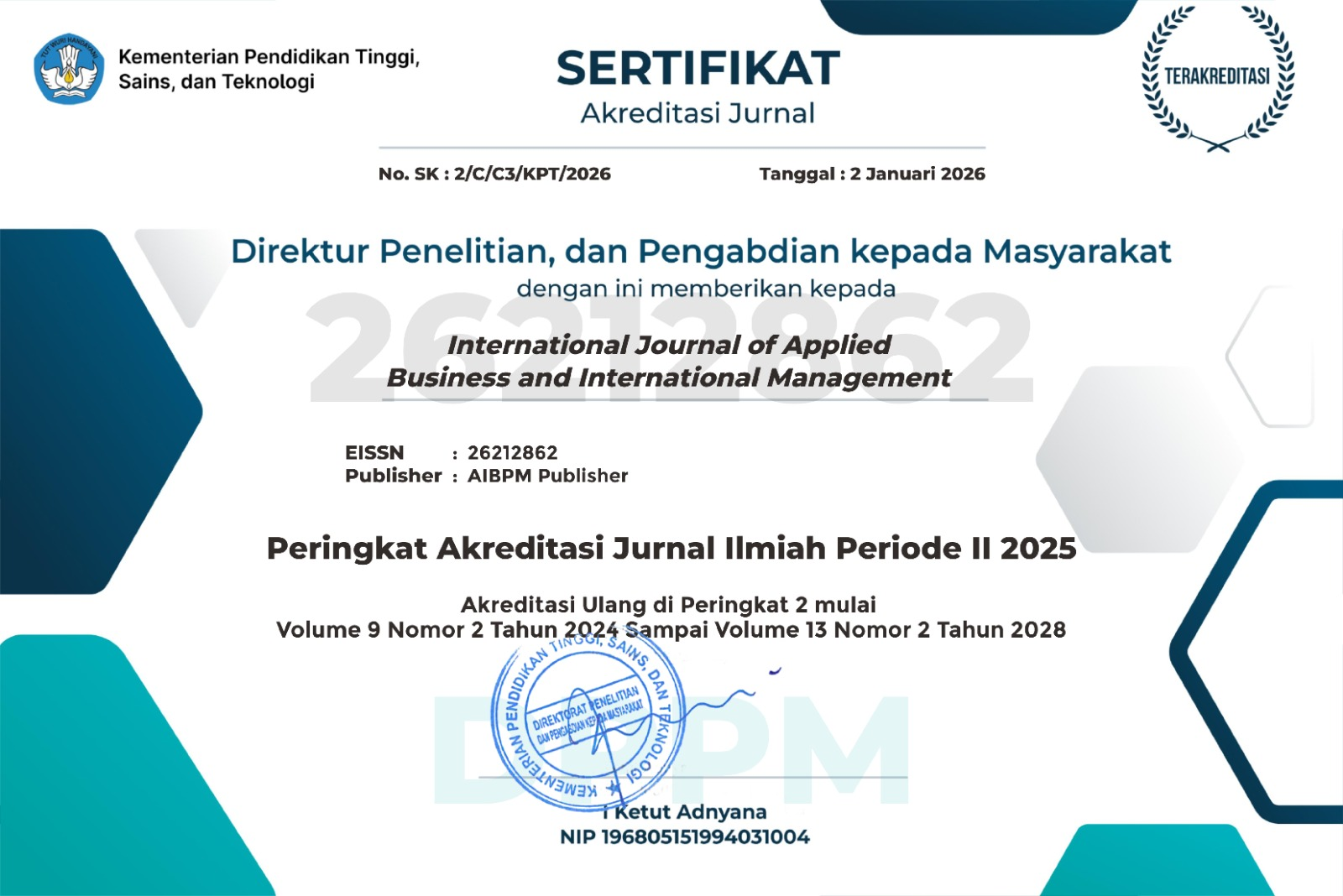
International Journal of Applied Business and International Management (IJABIM)
ISSN 2614-7432 (Print) | ISSN 2621-2862 (Online)
DOI Prefix: 10.32535 by CrossRef
Published by AIBPM Publisher
JL. Kawi No. 23, Bareng, Kec. Klojen, Kota Malang, Jawa Timur, Indonesia
Email: journal.ijabim@gmail.com
Phone: +62 341 366222
Website: https://aibpmpublisher.com/
Governed by
Association of International Business and Professional Management
Email: admin@aibpm.org
Website: https://www.aibpm.org/


Licensing Information

The International Journal of Applied Business and International Management (IJABIM) is licensed under a Creative Commons Attribution-NonCommercial-ShareAlike 4.0 International License .
Follow Us:

