





 Email this article
 Unlocking Financial Performance Through Islamic Corporate Governance and Islamic Social Reporting
Abstract
Despite the rapid growth of Islamic banking, the effectiveness of Islamic Corporate Governance (ICG) and Islamic Social Reporting (ISR) in improving financial performance remains inconclusive. This research aims to examine the influence of ICG and ISR on the financial performance of Islamic Commercial Banks (ICBs) in Indonesia. The research uses a quantitative approach, drawing on secondary data from annual reports and financial statements. The sample was selected through purposive sampling, and data were analyzed using panel data regression in Stata. Financial performance is proxied by Return on Assets (ROA), with variable controls including bank age, bank size, NPF, OER, CAR, and FDR. The data are analyzed using panel data regression with the Panel Corrected Standard Errors (PCSE) approach to address issues of heteroscedasticity and autocorrelation. The research results show that ICG has a positive and significant effect on financial performance (b = 0.926; p = 0.027), while ISR does not have a significant effect (b = -0.594; p = 0.187). The findings suggest that ICBs should prioritize strengthening the quality of ICG, particularly the effectiveness of Sharia governance, transparency, and supervisory mechanisms, as these directly impact profitability. Meanwhile, ISR should be transformed from a compliance-oriented disclosure into a strategic value-creation instrument that enhances stakeholder trust and contributes to long-term financial sustainability.
Keywords
Full Text:
PDFReferences
Adema, H., Tariq, K., & Carmelo, D. (2023). Disclosure of Islamic social reporting of Islamic banks in Indonesia with analysis of profitability and size for 2016-2020. Journal Markcount Finance, 1(1), 13–25. https://doi.org/10.55849/jmf.v1i1.54
Al-Sartawi, A. M. A. M. (2020). Shariah disclosure and the performance of Islamic financial institutions. Asian Journal of Business and Accounting, 13(1), 133–160.
Aryani, D. N., & Assegaf, H. H. (2026). Risk management and bank profitability: Moderating effects on lending and credit risk in Indonesia. International Journal of Applied Business and International Management, 11(1), 208–223. https://doi.org/10.32535/ijabim.v11i1.4506
Beck, N., & Katz, J. N. (1995). What to do (and not to do) with time-series cross-section data. American Political Science Review, 89, 634-647.
Billah, F. A. M., & Fianto, B. A. (2021). Pengaruh Islamic Corporate Governance terhadap kinerja bank Syariah: Studi empiris Indonesia Dan Malaysia. Jurnal Ekonomi Syariah Teori dan Terapan, 8(2), 243. https://doi.org/10.20473/vol8iss20212pp243-254
Caesaria, S. M., & Majidah, M. (2025). Determinants of audit quality: Evidence from consumer sectors in Indonesia. American Journal of Economic and Management Business, 4(7), 1007–1020. https://doi.org/10.58631/ajemb.v4i7.284
Darma, E. S., & Afandi, A. (2021). The role of Islamic Corporate Governance and risk toward Islamic banking performance: Evidence from Indonesia. Journal of Accounting and Investment, 22(3), Layouting. https://doi.org/10.18196/jai.v22i3.12339
Girma, A. M., Edriss, A. K., Jemal, K., & Lambamo, A. (2025). Does bank agricultural credit reduce poverty level and income inequality in Ethiopia: Panel Corrected Standard Errors (PCSE) approach. Research on World Agricultural Economy, 6(1), 100–116. https://doi.org/10.36956/rwae.v6i1.1414
Gita, A. M. A., & Prasetio, J. E. (2024). The effect of profitability in improving sustainability performance with good corporate governance as a moderating variable: A study on mining companies. International Journal of Applied Business and International Management, 9(3), 498–515. https://doi.org/10.32535/ijabim.v9i3.355
Haniffa, R. (2002). Social responsibility disclosure: An Islamic perspective. Indonesian Management & Accounting Research, 1(2), 128–146.
Hussain, A., Khan, M., Rehman, A., Zada, S. S., Malik, S., Khattak, A., & Khan, H. (2021). Determinants of Islamic social reporting in Islamic banks of Pakistan. International Journal of Law and Management, 63(1), 1–15. https://doi.org/10.1108/IJLMA-02-2020-0060
Isbah, F., Yuliana, R., & Herawati, N. (2024). Islamic Corporate Governance: A three decade bibliometric analysis. InCAF: Proceeding of International Conference on Accounting and Finance, 2(2021), 63–82. https://journal.uii.ac.id/inCAF/article/view/32587
Jati, K. W., Agustina, L., Muliasari, I., & Armeliza, D. (2020). Islamic Social Reporting disclosure as a form of social responsibility of Islamic banks in Indonesia. Banks and Bank Systems, 15(2), 47–55. https://doi.org/10.21511/bbs.15(2).2020.05
Jihadi, M., Vilantika, E., Widagdo, B., Sholichah, F., & Bachtiar, Y. (2021). Islamic Social Reporting on value of the firm: Evidence from Indonesia Sharia Stock Index. Cogent Business and Management, 8(1). https://doi.org/10.1080/23311975.2021.1920116
Kateb, I., Nafti, O., & Zeddini, A. (2025). How to improve the financial performance of Islamic banks in the MENA region? A Shariah governance perspective. International Journal of Emerging Markets, 20(6), 2559–2580. https://doi.org/10.1108/IJOEM-03-2023-0434
Khan, I., & Zahid, S. N. (2020). The impact of Shari’ah and corporate governance on Islamic banks performance: Evidence from Asia. International Journal of Islamic and Middle Eastern Finance and Management, 13(3), 483–501. https://doi.org/10.1108/IMEFM-01-2019-0003
Lestari, I. P., Hanafi, M. M., & Wardhana, L. I. (2025a). A literature review of updated islamic corporate governance elements: Implications for Indonesia. Journal of Islamic Monetary Economics and Finance, 11(1), 91–118. https://doi.org/10.21098/jimf.v11i1.2305
Lestari, I. P., Hanafi, M. M., & Wardhana, L. I. (2025b). Sustainability based Islamic Corporate Governance and Islamic banks’ multi-performance: Evidence From Indonesia. Journal of Islamic Monetary Economics and Finance, 11(4), 743–778. https://doi.org/10.21098/jimf.v11i4.2927
Minaryanti, A. A., & Mihajat, M. I. S. (2024). A systematic literature review on the role of Sharia governance in improving financial performance in Sharia banking. Journal of Islamic Accounting and Business Research, 15(4), 553–568. https://doi.org/10.1108/JIABR-08-2022-0192
Mukhibad, H., Rochmatullah, M. R., Warsina, W., Rahmawati, R., & Setiawan, D. (2020). Islamic Corporate Governance and performance based on Maqasid Sharia Index: Study in Indonesia. Jurnal Siasat Bisnis, 24(2), 114–126. https://doi.org/10.20885/jsb.vol24.iss2.art2
Murtiyanti, S., Kabib, N., & Aminah, S. (2022). Islamic bank financial performance is based on Islamic Corporate Social Responsibility, Islamic Corporate Governance and intellectual capital. Islamic Accounting Journal, 2(2), 28–59. https://doi.org/10.18326/iaj.v2i2.28-59
National Committee on Governance Policy (KNKG). (2011). Pedoman Umum Good Governance Bisnis Syariah. Komite Nasional Kebijakan Governansi (KNKG). https://drive.google.com/file/d/16l9BV1TXDMY_MxfD_xCFy0PiZdWeqoZE/view
Othman, R., Thani, A. M., & Ghani, E. K. (2009). Determinants of Islamic Social Reporting among top Shariah - Approved companies in Bursa Malaysia. Research Journal of International Studies, 12(12), 4–20. https://drive.google.com/file/d/1iV1ij9sFkEzl22gPDvgx-mLdRMK_cnRx/view?usp=drive_link
Pangerang, B., Setiawati, L., & Lahjie, A. A. (2025). Impact of Sharia compliance and Islamic Corporate Governance on financial performance of Islamic banks moderated by Islamic Corporate Social Responsibility. Proceeding of International Conference on Accounting and Finance, 3, 482–496. https://journal.uii.ac.id/inCAF/article/view/38764
Platonova, E., Asutay, M., Dixon, R., & Mohammad, S. (2018). The impact of Corporate Social Responsibility disclosure on financial performance: Evidence from the GCC Islamic Banking Sector. Journal of Business Ethics, 151(2), 451–471. https://doi.org/10.1007/s10551-016-3229-0
Quttainah, M. A., & BenSaid, Y. R. (2025). Shari’ah governance and financial performance: A bibliometric analysis and research agenda. Journal of Islamic Accounting and Business Research. https://doi.org/10.1108/JIABR-08-2024-0289
Rahim, M. A., Shaharuddin, N. ’Ain S., & Suki, N. M. (2024). Shariah governance disclosure and its effect on Islamic banks’ financial performance: Evidence from Malaysia and GCC countries. Journal of Islamic Accounting and Business Research, 15(4), 619–642. https://doi.org/10.1108/JIABR-08-2021-0235
Salman, K. R. (2023). What drives the level of social reporting disclosure at Islamic commercial banks? Banks and Bank Systems, 18(4), 61–73. https://doi.org/10.21511/bbs.18(4).2023.06
Susbiyani, A., Halim, M., & Animah, A. (2023). Determinants of Islamic Social Reporting disclosure and its effect on firm’s value. Journal of Islamic Accounting and Business Research, 14(3), 416–435. https://doi.org/10.1108/JIABR-10-2021-0277
Tashkandi, A. A. (2023). Shariah supervision and corporate governance effects on Islamic banks’ performance: Evidence from the GCC countries. Journal of Business and Socio-Economic Development, 3(3), 253–264. https://doi.org/10.1108/JBSED-02-2022-0024
Tumewang, Y. K., Supriani, I., Dewi, H. R., & Alam, M. K. (2025). An extended review on Sharia governance studies from 1985 to 2022. Journal of Islamic Accounting and Business Research, 16(2), 321–347. https://doi.org/10.1108/JIABR-11-2022-0319
Umiyati, L. M. M. K. (2020). Islamic Corporate Governance and Sharia compliance on financial performance Sharia bank in Indonesia. Al-IQTISHAD: Jurnal Ilmu Ekonomi Syariah (Journal of Islamic Economics), 12(1), 33–50. https://doi.org/https://doi.org/10.15408/aiq.v12i1.15053
Wairooy, F. A., & Haryono, S. (2023). Does Islamic Corporate Governance moderation the influence of Sharia financial performance toward Islamic Social Reporting? Journal of Islamic Economic Laws, 6(2), 60–88. https://doi.org/10.23917/jisel.v6i2.22358
Wibowo, D. (2022). Analysis of the effect of Islamic Corporate Governance on the financial performance of Islamic banking in Indonesia. Jurnal Ilmiah Ekonomi Islam, 8(3), 3501. https://doi.org/10.29040/jiei.v8i3.6799
Wijayanti, R., Aryani, Y. A., & Setiawan, D. (2023). Islamic Social Reporting in Indonesian Islamic Bank: A systematic literature review. Global Business & Finance Review, 28(5), 82–98. https://doi.org/10.17549/gbfr.2023.28.5.82
Wiratama, R. H., & Prasetio, J. E. (2025). The role of good corporate governance and corporate social responsibility in shaping the financial performance of IDX-listed mining companies (2019–2023). International Journal of Applied Business and International Management, 10(2), 228–245. https://doi.org/10.32535/ijabim.v10i2.3854
Zidi, M., & Hamdi, H. (2024). A Panel-corrected Standard Error (PCSE) framework to estimate capital structure and banking performance within the Tunisian context. International Journal of Economics and Financial Issues, 14(2), 196–202. https://doi.org/10.32479/ijefi.15793
DOI: https://doi.org/10.32535/ijabim.v11i2.4719
Refbacks
- There are currently no refbacks.

Copyright (c) 2026 Mira Munira, Muhammad Hakimi Mohd Shafiai

This work is licensed under a Creative Commons Attribution-NonCommercial-ShareAlike 4.0 International License.
International Journal of Applied Business and International Management (IJABIM)
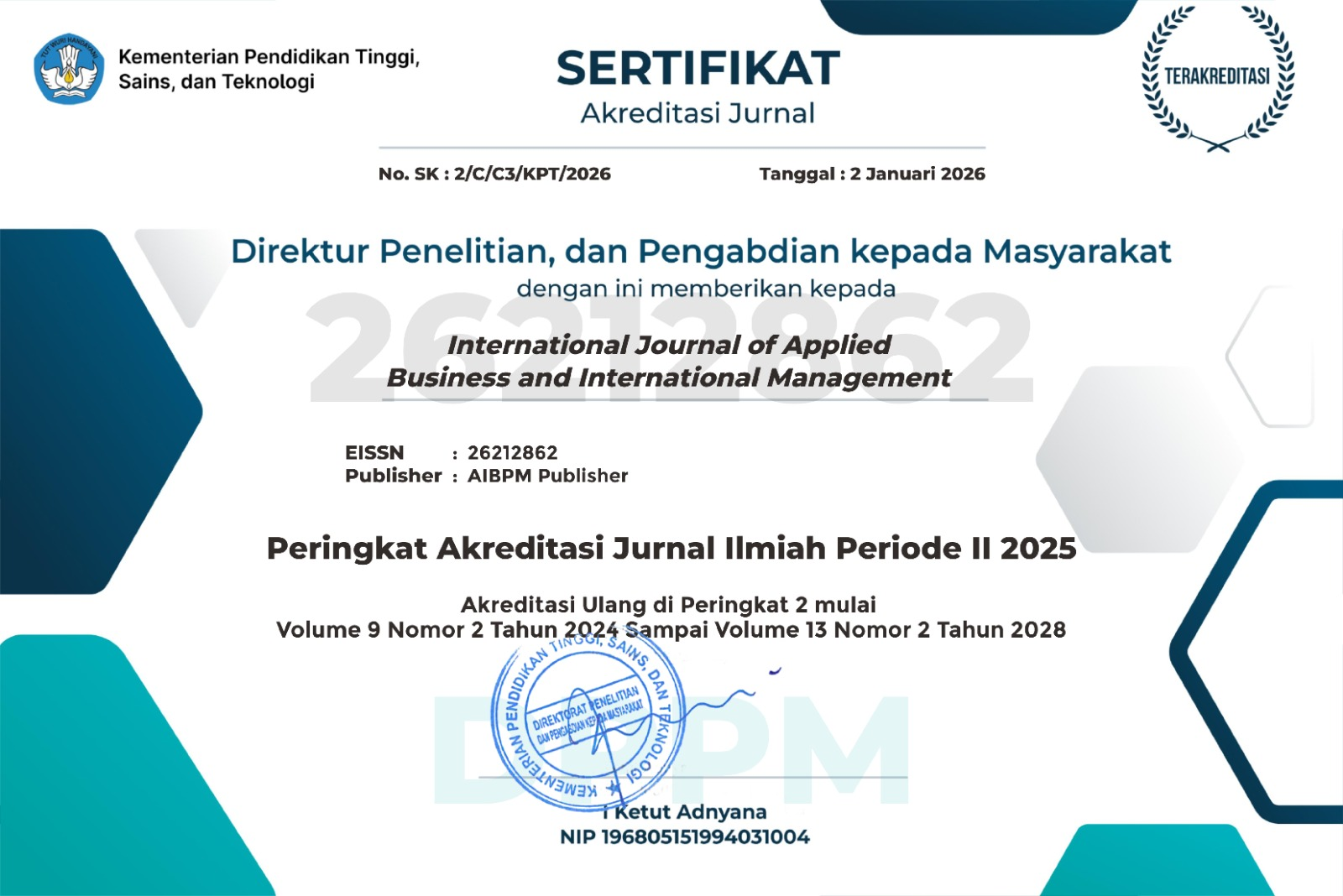
ISSN 2614-7432 (Print) | ISSN 2621-2862 (Online)
DOI Prefix: 10.32535 by CrossRef
Published by AIBPM Publisher
JL. Kawi No. 23, Bareng, Kec. Klojen, Kota Malang, Jawa Timur, Indonesia
Email: journal.ijabim@gmail.com
Phone: +62 341 366222
Website: https://aibpmpublisher.com/
Governed by
Association of International Business and Professional Management
Email: admin@aibpm.org
Website: https://www.aibpm.org/


Licensing Information

The International Journal of Applied Business and International Management (IJABIM) is licensed under a Creative Commons Attribution-NonCommercial-ShareAlike 4.0 International License .
Follow Us:

