








The Role of Asset Diversification in Moderating the Influence of Income Smoothing and Signaling on Loan Loss Provisions
Abstract
Keywords
Full Text:
PDFReferences
Adzis, AA, Anuar, H., Shah Anuar, H., Shahieda, N., & Hishamuddin, M. (2015). Do Income Smoothing, Capital Management, Signaling, and Pro-Cyclicality Exist Through Loan Loss Provisions? Journal of Economics, Finance and Management, 4(2).http://www.ejournalofbusiness.org
Agung, J., Harun, CA, & Deriantino, E. (2021). Macroprudential Policy in Indonesia (1st ed., Vol. 1). Rajawali Pers.
Avinda, I. N., Hidayat, A. M., & Kartawinata, B. R. (2025). The influence of financial performance and ESG on firm value with firm size as moderator. International Journal of Accounting & Finance in Asia Pacific, 8(2), 257-273.
Ayem, S., & Ina, C. R. T. (2023). Struktur modal dan likuiditas terhadap nilai perusahaan: ukuran perusahaan sebagai variabel moderasi. Jurnal Literasi Akuntansi, 3(1), 47-57. https://doi.org/10.55587/jla.v3i1.48
Beaver, W.H. and Engel, E. (1996), “Discretionary behavior with respect to allowances for loan losses and the behavior of security prices”, Journal of Accounting and Economics, Vol. 22 No. 1-3, pp. 177-206
Bouvatier, V., & Lepetit, L. (2013). Effects of Loan Loss Provisions on Growth in Bank Lending: Some International Comparisons. Economie https://doi.org/10.1016/s2110-7017(13)60059-1
Bouvatier, V., Lepetit, L., & Strobel, F. (2014). Bank income smoothing, ownership concentration and the regulatory environment. Journal of Banking & Finance, 41, 253-270.
Caporale, G.M., Alessi, M., Di Colli, S., & Lopez, J.S. (2018). Loan Loss Provisions and Macroeconomic Shocks: Some Empirical Evidence for Italian Banks During the Crisis. Finance Research Letters, 25, 239–243.https://doi.org/10.1016/j.frl.2017.10.031
Curcio, D., & Hasan, I. (2015). Earnings and capital management and signaling: the use of loan-loss provisions by European banks. The European Journal of Finance, 21(1), 26-50.
Desmiwerita, Ardiany, Y., Herfina, M., Yadewani, D., & Jannah, M. (2026). The effect of Good Corporate Governance and cash holding on income smoothing in Indonesian manufacturing companies. International Journal of Accounting and Finance in Asia Pacific, 9(1), 389–407.
Ghozali, I., & Dwi, R. (2017). Multivariate Analysis and Econometrics, Theory, Concepts, and Applications with Eviews 10. Diponegoro University Publishing Agency
Huynh, D. H., & Vo, Q. T. (2024). Authentic leadership, organizational culture, competitive advantages, and firm performance: Empirical evidence from Vietnam. Global Business and Finance Review, 29(8), 18-30. doi:10.17549/gbfr.2024.29.8.18
Jasman, J., Murwaningsari, E., Mayangsari, S., & Mulyani, SD (2021). The Effect of Earnings Management and Signaling on Loss Loan Provision: The Role of Bank Capitalization. Journal of Finance and Banking Review, 6(1), 43–50.https://doi.org/10.35609/jfbr.2021.6.1(1)
Kivits, R., & Sawang, S. (2021). The dynamism of stakeholder engagement: A case study of the aviation industry. Switzerland: Springer. https://www.springer.com/series/1505
Lobo, G. J. (2017). Accounting research in banking: A review. China Journal of Accounting Research, 10(1), 1-7
Raharja, M. D., & Budiharjo, R. (2026). Profitability, CSR, institutional ownership, and independent commissioners’ effect on firm value in the Indonesian food and beverage sector. International Journal of Accounting and Finance in Asia Pacific, 9(2), 815-831.
Financial Services Authority (OJK). (2019). Financial Services Authority Regulation Number 37/POJK.03/2019 dated December 19, 2019 concerning Transparency and Publication of Bank Reports. Accessed on June 8, 2026 from http://www.ojk.go.id.
Pramono, SE, Rossieta, H., & Soedarmono, W. (2019). Income Smoothing Behavior and The Procyclical Effect of Loan Loss Provisions in Islamic Banks: Global Evidence. Journal of Islamic Accounting and Business Research, 10(1), 21–34. https://doi.org/10.1108/JIABR-09-2014-0032
Pramono, SE (2021). Detecting Procyclical Effects. A Global Study on Islamic Banking. CV. Amerta Media.
Shala, A., & Toçi, V. (2021). Bank Provisioning Behavior, Procyclicality and Capital Management in South Eastern Europe. Ekonomicky Casopis, 69(1), 3–17. https://doi.org/10.31577/ekoncas.2021.01.01
Shala, A., Toçi, V., & Ahmeti, S. (2020). Income Smoothing Through Loan Loss Provisions in South and Eastern European Banks. Zbornik Radova Ekonomskog Fakultet Au Rijeci, 38(2), 429–452. https://doi.org/10.18045/zbefri.2020.2.429
Soedarmono, W., Pramono, SE, & Tarazi, A. (2017). The Procyclicality of Loan Loss Provisions in Islamic Banks. in International https://doi.org/10.1016/j.ribaf.2016.05.003
Stolowy, H., & Breton, G. (2004). Accounts Manipulation: A Literature Review and Proposed Conceptual Framework. Review of Accounting & Finance, Vol. 3(1), 5-66.
Valdiansyah, RH, Murwaningsari, E., & Mayangsari, S. (2023). Does IFRS 7 Disclosure Weaken Earnings Management? Evidence from Indonesian Conventional Commercial Banks. Journal of Finance and Risk Perspectives, 11(1), 158–174.https://doi.org/10.35944/jofrp.2022.11.1.009
Wang, Z., Xie, N., & Jin, Y. (2019). Do Loan Loss Provisions Affect the Credit Fluctuations in China's Banking System? Emerging Markets Finance https://doi.org/10.1080/1540496X.2018.1553159
DOI: https://doi.org/10.32535/ijafap.v9i3.4770
Refbacks
- There are currently no refbacks.
Copyright (c) 2026 Yudi Yudi

This work is licensed under a Creative Commons Attribution-NonCommercial-ShareAlike 4.0 International License.
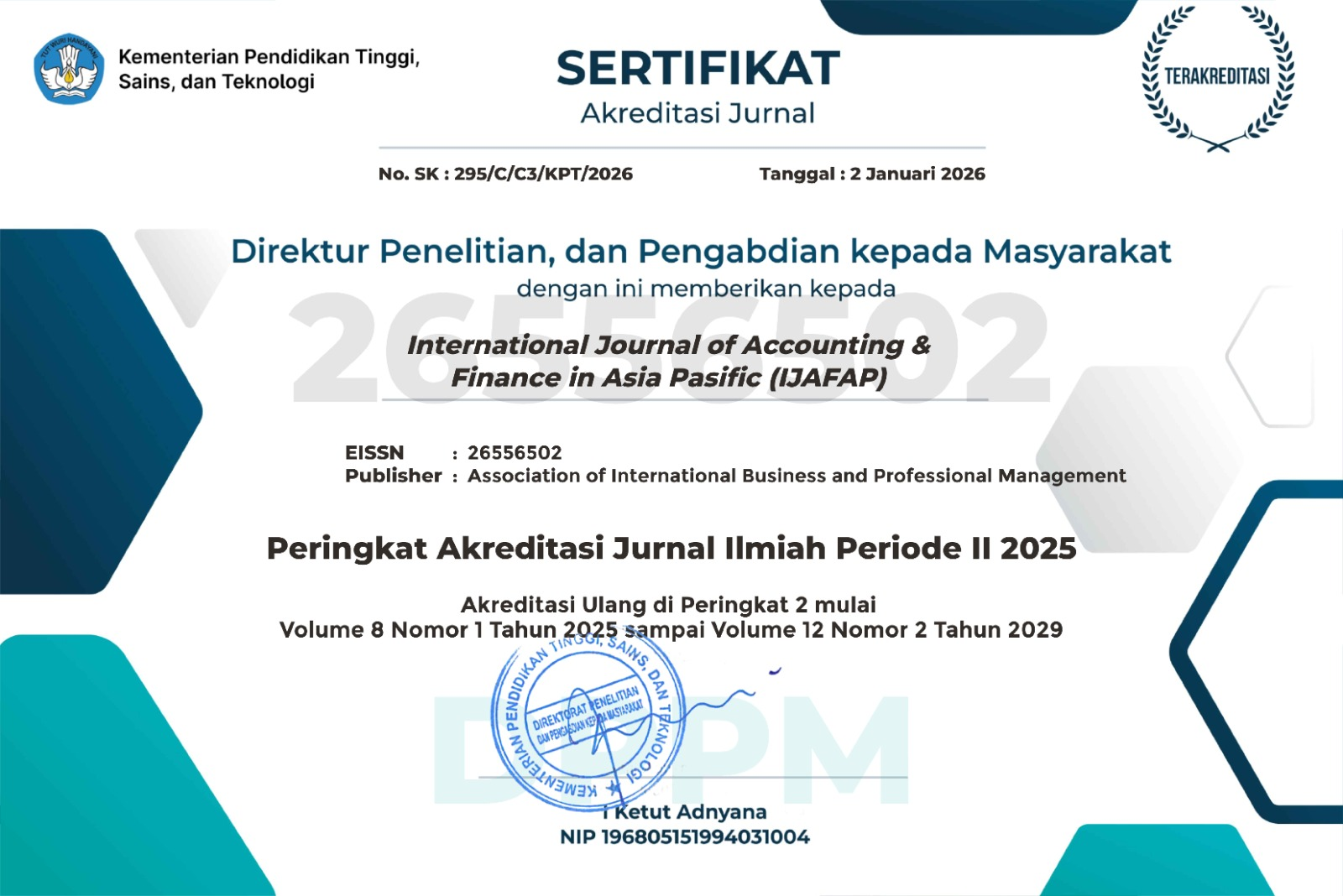
International Journal of Accounting and Finance in Asia Pacific (IJAFAP)
ISSN 2684-9763 (Print) | ISSN 2655-6502 (Online)
DOI Prefix: 10.32535 by CrossRef
Published by AIBPM Publisher
JL. Kawi No. 23, Bareng, Klojen, Kota Malang, Jawa Timur, Indonesia
Email: adm.ijafap@gmail.com
Phone: +62 896-8679-1980
Website: https://ejournal.aibpmjournals.com/index.php/IJAFAP
Governed by
Association of International Business and Professional Management
Email: admin@aibpm.org
Website: https://www.aibpm.org/
Indexed by








Licensing Information

International Journal of Accounting and Finance in Asia Pacific (IJAFAP) is licensed under a Creative Commons Attribution-NonCommercial-ShareAlike 4.0 International License.