





 Email this article
 Financial Performance Determinants: Sustainability Reporting, CSR, Environmental Performance, and Green Innovation in Indonesian Manufacturing Firms
Abstract
Manufacturing firms in emerging economies face growing pressure to balance profitability and sustainability, yet their financial outcomes remain inconclusive. This study aims to examine the effects of sustainability reporting (SR), corporate social responsibility (CSR), and environmental performance (EP) on the financial performance (FP) of Indonesian manufacturing firms during 2020–2024, while investigating the moderating role of green innovation (GI). Using a quantitative panel-data design with purposive sampling, data from 42 manufacturing firms (210 firm-year observations) were analyzed using multiple linear regression in STATA 17. The Common Effect Model (R² = 0.2707) indicates that SR (b = 1.162, p = 0.024), CSR (b = 3.363, p = 0.047), and GI (b = 6.090, p = 0.039) have significant positive effects on FP, whereas EP has a positive but insignificant effect (p = 0.583). Furthermore, GI negatively moderates the relationships between SR and FP (b = ?30.809, p = 0.006) and between EP and FP (b = ?6.206, p = 0.015), while its moderating effect on the CSR–FP relationship is insignificant (p = 0.619). These findings suggest that firms should strategically balance green-technology investment and sustainability initiatives to manage potential short-term resource trade-offs while pursuing long-term financial performance.
Keywords
Full Text:
PDFReferences
Alsulami, F. (2024). The operational risk disclosure threshold effect in the earnings management–sustainability firm performance nexus in Saudi Arabia: A dynamic panel threshold regression model. Sustainability, 16(10), 4264. https://doi.org/10.3390/su16104264
Barney, J. B. (1991). Firm resources and sustained competitive advantage. Journal of Management, 17(1), 99–120. https://doi.org/10.1177/014920639101700108
Bonsu, M. O. A., Guo, Y., & Zhu, X. (2024). Does green innovation mediate corporate social responsibility and environmental performance? Empirical evidence from emerging markets. Journal of Applied Accounting Research, 25(2), 221–239. https://doi.org/10.1108/JAAR-10-2022-0271
Casciello, R., Santonastaso, R., Prisco, M., & Martino, I. (2024). Green innovation and financial performance: The role of R&D investments and ESG disclosure. Corporate Social Responsibility and Environmental Management, 31(6), 5372–5390. https://doi.org/10.1002/csr.2862
Chouaibi, S., Chouaibi, J., & Rossi, M. (2022). ESG and corporate financial performance: The mediating role of green innovation: UK common law versus Germany civil law. EuroMed Journal of Business, 17(1), 46–71. https://doi.org/10.1108/EMJB-09-2020-0101
Deegan, C. M. (2019). Legitimacy theory: Despite its enduring popularity and contribution, time is right for a necessary makeover. Accounting, Auditing & Accountability Journal, 32(8), 2307–2329. https://doi.org/10.1108/AAAJ-08-2018-3638
Dhanani, A., & Kennedy, D. (2023). Envisioning legitimacy: visual dimensions of NGO annual reports. Accounting, Auditing & Accountability Journal, 36(1), 348-377. https://doi.org/10.1108/AAAJ-01-2020-4377
Dutt, O., & Dwivedi, A. (2023). Impact of corporate social performance on profitability: A case study of listed Indian companies. International Journal of Professional Business Review, 8(10), Article e3879. https://doi.org/10.26668/businessreview/2023.v8i10.3879
Fitriasari, R. (2023). The impact of sustainability corporate governance on corporate environmental disclosure. International Journal of Accounting & Finance in Asia Pacific, 6(1), 70–81. https://doi.org/10.32535/ijafap.v6i1.217
Freeman, R. E. (1984). Strategic management: A stakeholder approach. Pitman.
Global Reporting Initiative (GRI). (2021). GRI standards 2021: Consolidated set of standards. GRI. https://www.globalreporting.org/standards/
Ha, N. M., Nguyen, P. A., Luan, N. V., & Tam, N. M. (2024). Impact of green innovation on environmental performance and financial performance. Environment, Development and Sustainability, 26(7), 17083-17104. https://doi.org/10.1007/s10668-023-03328-4
Ismail, A. M., & Azman, K. B. B. (2024). The impact of environmental, social, and governance performance on financial performance: Evidence from Japanese companies. Edelweiss Applied Science and Technology, 8(3), 236–258. https://doi.org/10.55214/25768484.v8i3.950
Kayani, U. N., Gan, C., Rabbani, M. R., & Trichilli, Y. (2024). Is short-term firm performance an indicator of a sustainable financial performance? Empirical evidence. Studies in Economics and Finance, 41(3), 619–637. https://doi.org/10.1108/SEF-03-2023-0136
Kiyak, D., & Grigoliene, R. (2023). Analysis of the conceptual frameworks of green marketing. Sustainability, 15(21), Article 15630. https://doi.org/10.3390/su152115630
Maulana, M. F., & Prasetio, J. E. (2025). The effect of sustainability report, green accounting, and leverage on corporate values in energy sector companies. International Journal of Applied Business and International Management, 10(1), 36–51. https://doi.org/10.32535/ijabim.v10i1.3813
Muqorobin, M. M., & Simamora, A. J. (2025). Effect of environmental performance on firm value in Indonesian Stock Exchange: Intervening role of profitability. Journal of Trends Economics and Accounting Research, 5(4), 507–515. https://doi.org/10.47065/jtear.v5i4.1925
Odeyemi, O., Usman, F. O., Mhlongo, N. Z., Elufioye, O. A., & Ike, C. U. (2024). Sustainable entrepreneurship: A review of green business practices and environmental impact. World Journal of Advanced Research and Reviews, 21(2), 346-358. https://doi.org/10.30574/wjarr.2024.21.2.0461
Porter, M. E., & van der Linde, C. (1995). Toward a new conception of the environment-competitiveness relationship. Journal of Economic Perspectives, 9(4), 97–118. https://doi.org/10.1257/jep.9.4.97
Putra, Y. P., & Subroto, T. A. (2022). Pengaruh pengungkapan sustainability report terhadap kinerja keuangan perusahaan. EKOMBIS Review: Jurnal Ilmiah Ekonomi dan Bisnis, 10(2), 1327–1338. https://doi.org/10.37676/ekombis.v10i2.2272
Sabihaini, S., Prasetio, J. E., Ladiqi, S., Abdul Rahman, H. B., & Rusdiyanto. (2026). The mediating role of environmental sustainable development between corporate social responsibility and green innovation. International Journal of Accounting and Finance in Asia Pacific, 9(2), 613–631. https://doi.org/10.32535/ijafap.v9i2.4402
Sarfraz, M., Ozturk, I., Yoo, S., Raza, M. A., & Han, H. (2023). Toward a new understanding of environmental and financial performance through corporate social responsibility, green innovation, and sustainable development. Humanities and Social Sciences Communications, 10(1), Article 297. https://doi.org/10.1057/s41599-023-01799-4
Setyowati, S. D., Mutmainnah, M., & Ponto, S. (2024). Pengaruh sustainability report terhadap kinerja keuangan (studi pada sektor pertambangan yang terdaftar di Bursa Efek Indonesia periode 2018–2022). Jurnal Bisnis Mahasiswa, 4(2), 112–124. https://doi.org/10.60036/jbm.v4i2.art1
Spence, M. (1973). Job market signaling. Quarterly Journal of Economics, 87(3), 355–374. https://doi.org/10.2307/1882010
Suchman, M. C. (1995). Managing legitimacy: Strategic and institutional approaches. Academy of Management Review, 20(3), 571–610. https://doi.org/10.2307/258788
Sugiyono, S. (2021). Metode Penelitian Kuantitatif, Kualitatif, dan R&D. Alfabeta.
Sukirman, A. S., & Dianawati, W. (2023). Green intellectual capital and financial performance: The moderating role of family ownership. Cogent Business & Management, 10(1), Article 2200498. https://doi.org/10.1080/23311975.2023.2200498
Teece, D. J., Pisano, G., & Shuen, A. (1997). Dynamic capabilities and strategic management. Strategic Management Journal, 18(7), 509–533. https://doi.org/10.1002/(SICI)1097-0266(199708)18:7<509::AID-SMJ882>3.0.CO;2-Z
Teoh, K. B., Lim, H. L., Cheah, F. N., Chai, J. X., Chan, S. L., ..., & Kee, D. M. H. (2025). Exploring the impact of sustainability, corporate social responsibility, and service quality on corporate brand reputation. International Journal of Tourism and Hospitality in Asia Pasific, 8(2), 237–252. https://doi.org/10.32535/ijthap.v8i2.3990
DOI: https://doi.org/10.32535/ijabim.v11i1.4525
Refbacks
- There are currently no refbacks.

Copyright (c) 2026 Dewi Maryati

This work is licensed under a Creative Commons Attribution-NonCommercial-ShareAlike 4.0 International License.
International Journal of Applied Business and International Management (IJABIM)
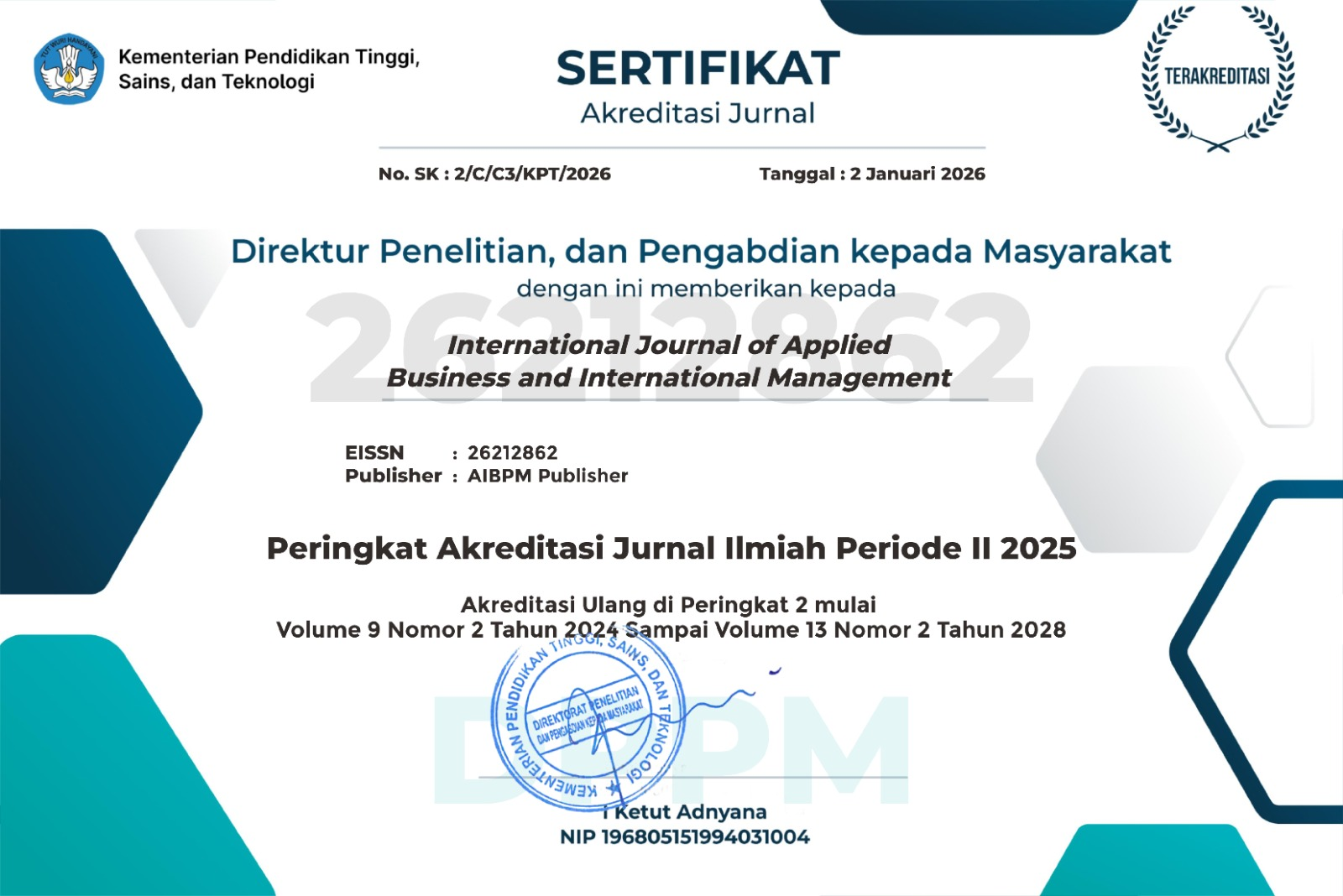
ISSN 2614-7432 (Print) | ISSN 2621-2862 (Online)
DOI Prefix: 10.32535 by CrossRef
Published by AIBPM Publisher
JL. Kawi No. 23, Bareng, Kec. Klojen, Kota Malang, Jawa Timur, Indonesia
Email: journal.ijabim@gmail.com
Phone: +62 341 366222
Website: https://aibpmpublisher.com/
Governed by
Association of International Business and Professional Management
Email: admin@aibpm.org
Website: https://www.aibpm.org/


Licensing Information

The International Journal of Applied Business and International Management (IJABIM) is licensed under a Creative Commons Attribution-NonCommercial-ShareAlike 4.0 International License .
Follow Us:

