





 Email this article
 Digital Readiness, Agility, and Creativity as Drivers of Competitive Advantage in the Creative Industry
Abstract
This study examines the role of digital readiness in enhancing the competitiveness of creative industry MSMEs by analyzing its relationship with digital agility and digital creativity. It specifically investigates how digital readiness directly and indirectly influences digital competitiveness through the mediating roles of digital agility and digital creativity. Using a quantitative approach with Structural Equation Modeling (SEM), this study analyzes data from micro, small, and medium enterprises (MSMEs) operating in the creative industry sector, particularly the fashion, culinary, and craft subsectors, in West Java, Indonesia. The findings reveal that digital readiness significantly influences digital agility, digital creativity, and digital competitiveness. Digital agility positively affects both digital creativity and digital competitiveness, while digital creativity significantly contributes to strengthening digital competitiveness. The results also indicate that digital agility and digital creativity jointly mediate the relationship between digital readiness and digital competitiveness. These findings suggest that digital readiness serves as a fundamental capability that enables MSMEs to adapt quickly to digital transformation, stimulate creativity, and improve their competitiveness in digital markets. The integration of readiness, agility, and creativity forms a strategic synergy that supports the sustainability and competitive advantage of creative industry businesses. This study contributes to the literature by developing an integrated framework linking digital readiness, digital agility, and digital creativity to digital competitiveness within the MSME creative industry context. Practically, the findings offer insights for MSME managers and policymakers to strengthen digital infrastructure, develop digital competencies, and encourage innovative practices to improve competitiveness in the digital economy. Its novelty lies in proposing a comprehensive digital competitiveness model that positions digital agility and digital creativity as key mediating mechanisms linking digital readiness to competitive advantage in the creative industry.
Keywords
Full Text:
PDFReferences
Abudaqa, A., & Noburu, I. (2024). Optimizing Digipreneurship in the Growth of the Digital Millennial Creative Economy Ecosystem. Startupreneur Business Digital (Sabda Journal), 4(1), 24-34. https://doi.org/10.33050/sabda.v4i1.681
Adhiatma, A., Fachrunnisa, O., Nurhidayati, N., & Rahayu, T. (2022). Creating digital ecosystem for small and medium enterprises: the role of dynamic capability, agile leadership and change readiness. Journal of Science and Technology Policy Management, 14(5), 941-959. https://doi.org/10.1108/jstpm-12-2020-0171
Amabile, T. M. (1996). Creativity in context: Update to the social psychology of creativity. Westview Press.
Bharadwaj, A., El Sawy, O. A., Pavlou, P. A., & Venkatraman, N. (2013). Digital business strategy: Toward a next generation of insights. MIS Quarterly, 37(2), 471–482. https://doi.org/10.25300/MISQ/2013/37:2.3
Badan Pusat Statistik. (2023). Statistik ekonomi kreatif Indonesia 2023. Badan Pusat Statistik Republik Indonesia.
Budiarto, D., Septiani, R., & Herawan, T. (2024). Competitive Advantage as a Bridge to Increase SMEs Sustainability. International Journal of Sustainable Development and Planning, 19(7), 2597-2603. https://doi.org/10.18280/ijsdp.190716
Doly, P. (2025). Bridging the Innovation Gap: Strategic Digital Transformation in Indonesia’s Creative Industries. Journal of Social Research, 4(9), 2407-2423. https://doi.org/10.55324/josr.v4i9.2737
Evmenov, A., & Enikeeva, L. (2025). Managing the digital transformation of creative industries to ensure the economic sovereignty of Russia: Problems and prospects in the Northwestern Federal District. Economics and Management, 31(8), 1001-1015. https://doi.org/10.35854/1998-1627-2025-8-1001-1015
Fariza, M., Norhan, L., Nurkhalisha, M., & Mokoagow, A. (2025). Optimizing Digital Platforms as a Strategy to Improve the Skills of Creative Industry Players in MSMEs Assisted by CIC Hub Cirebon. Journal of Economics and Management Sciences, 125-130. https://doi.org/10.37034/jems.v8i1.243
Hamdan, H., Nabila, E., Gunawan, R., Valentie, A., & Rivero, C. (2025). Digitalization of Financial Literacy and Social Media as a Sustainable Economic Strategy in Food & Beverages. Adi Bisnis Digital Interdisiplin Jurnal, 6(1), 99-107. https://doi.org/10.34306/abdi.v6i1.1229
Kementerian Pariwisata dan Ekonomi Kreatif Republik Indonesia. (2023). Laporan kinerja ekonomi kreatif 2023. Kemenparekraf RI.
Nambisan, S., Lyytinen, K., Majchrzak, A., & Song, M. (2017). Digital innovation management: Reinventing innovation management research in a digital world. MIS Quarterly, 41(1), 223–238. https://doi.org/10.25300/MISQ/2017/41:1.03
Priambada, S. (2023). Digital learning culture in dynamic capabilities and financial aspect as means for creative industry SMEs towards digital business. 217-228. https://doi.org/10.11594/futscipress24
Prasetyo, D. (2025). The Effectiveness of Digital Technology Implementation in Enhancing the Competitiveness of MSMEs in the Creative Industry of Tangerang City. Sketsa Bisnis, 12(1), 64-84. https://doi.org/10.35891/jsb.v12i1.6361
Porter, M. E. (1985). Competitive advantage: Creating and sustaining superior performance. Free Press.
Rifani, S., Arif, N., Wijaya, R., & Rahman, F. (2025). The Impact of Digital Marketing, Market Orientation, Entrepreneurial Competencies, and Entrepreneurship Characteristics on the Fashion MSMEs Performance in Yogyakarta. International Journal of Applied Business and International Management, 10(1), 50-68. https://doi.org/10.32535/ijabim.v10i1.3879
Suyanto, S. (2023). The Implementation of the Pancasila Economy to Empower MSMEs Post Pandemic Covid 19. Jurnal Pusaka, 12(1), 65-73. https://doi.org/10.35897/ps.v12i1.954
Tlessova, E. (2025). Participation of small and medium businesses in creative industries: current state and development prospects. Bulletin of Turan University, (4), 113-129. https://doi.org/10.46914/1562-2959-2025-1-4-113-129
Teece, D. J. (2007). Explicating dynamic capabilities: The nature and microfoundations of (sustainable) enterprise performance. Strategic Management Journal, 28(13), 1319–1350. https://doi.org/10.1002/smj.640
Teece, D. J., Pisano, G., & Shuen, A. (1997). Dynamic capabilities and strategic management. Strategic Management Journal, 18(7), 509–533. https://doi.org/10.1002/(SICI)1097-0266(199708)18:7<509::AID-SMJ882>3.0.CO;2-Z
Vial, G. (2019). Understanding digital transformation: A review and a research agenda. The Journal of Strategic Information Systems, 28(2), 118–144. https://doi.org/10.1016/j.jsis.2019.01.003
Warner, K. S. R., & Wäger, M. (2019). Building dynamic capabilities for digital transformation: An ongoing process of strategic renewal. Long Range Planning, 52(3), 326–349. https://doi.org/10.1016/j.lrp.2018.12.001
Westerman, G., Bonnet, D., & McAfee, A. (2014). Leading digital: Turning technology into business transformation. Harvard Business Review Press.
Westerman, G., Bonnet, D., Ferraris, P., & Sapp, J. (2014). Digital Transformation: A Roadmap for Billion-Dollar Organizations. MIT Center for Digital Business.
Yulianti, S., Indrajaya, T., Supriyani, M., Sova, M., Aliva, S., & Ferdiansyah, A. (2022). Entrepreneurial management in the development pattern of micro, small and medium enterprises (MSMEs) based on the digital creative economy in Mekarjaya village, Sukmajaya District, Depok City. Indonesian Journal of Engagement Community Services Empowerment and Development, 2(3), 359-367. https://doi.org/10.53067/ijecsed.v2i3.84
Yulianti, S., M. Sova, T. Indrajaya, M. Supriyani, R. Rushadiyati, C. Christina, … & S. Aliva. (2022). The Efforts to Improve Products for Development of Micro Small Medium Enterprises (MSMEs) Based on Digital Creative Economy in the South Tangerang Region. International Journal of Engagement and Empowerment (Ije2), 2(2), 191-200. https://doi.org/10.53067/ije2.v2i2.70
Zhou, K. Z., Wu, F., & Luo, X. (2005). Market orientation, IT capability, and firm performance: The moderating role of environment. Journal of Business Research, 58(9), 1247–1255. https://doi.org/10.1016/j.jbusres.2004.01.001
Alavijeh, H., Hashemzadeh, G., & Esfeden, G. (2025). Identification and Evaluation of Agile Criteria in the Iranian Telecom Industry Based on Digital Transformation Trends. IJIMOB, 5(1), 107-117. https://doi.org/10.61838/kman.ijimob.5.1.11
Aluwi, A., Omar, M., Hussien, N., Bakar, S., & Ahmad, M. (2024). The Smart Organization Movement: A Review and Research Agenda for Digital Competencies. Information Management and Business Review, 16(3S(I)a), 659-668. https://doi.org/10.22610/imbr.v16i3s(i)a.4226
Bharadwaj, A. (2003). Shaping Agility through Digital Options: Reconceptualizing the Role of Information Technology in Contemporary Firms. MIS Quarterly, 27(2), 237-263. https://doi.org/10.2307/30036530
Duvivier, F. & Gupta, G. (2023). Unleashing Digital Agility. Journal of Global Information Management, 31(8), 1-22. https://doi.org/10.4018/jgim.331092
Fitriani, A. (2026). Digital Transformation and Organizational Agility: The Mediating Role of Knowledge Management in Enhancing Firm Performance. Asian Journal of Applied Business and Management, 5(1), 61-74. https://doi.org/10.55927/ajabm.v5i1.6
Jing, Z., Zheng, Y., & Guo, H. (2023). A Study of the Impact of Digital Competence and Organizational Agility on Green Innovation Performance of Manufacturing Firms—The Moderating Effect Based on Knowledge Inertia. Administrative Sciences, 13(12), 250. https://doi.org/10.3390/admsci13120250
Putra, I. (2025). The Role of Organizational Agility and Innovation Capabilities as Mediators in Improving Sustainable Performance through Digital Transformational Leadership. International Journal of Social Science and Business, 9(2), 334-345. https://doi.org/10.23887/ijssb.v9i2.96151
Rožman, M., Oreški, D., & Tominc, P. (2023). A Multidimensional Model of the New Work Environment in the Digital Age to Increase a Company’s Performance and Competitiveness. IEEE Access, 11, 26136-26151. https://doi.org/10.1109/access.2023.3257104
Salmela, H., Baiyere, A., Tapanainen, T., & Galliers, R. (2022). Digital Agility: Conceptualizing Agility for the Digital Era. Journal of the Association for Information Systems, 23(5), 1080-1101. https://doi.org/10.17705/1jais.00767
Syarkani, Y. (2025). The Mediating Role of Organizational Agility in the Relationship Between Digital Transformation and Firm Performance. Journal of Social and Economics Research, 7(2), 102-116. https://doi.org/10.54783/jser.v7i2.1057
Yosufzai, S. & Siddiqui, M. (2023). Driving Quality Performance through Digitization and Technology Management: Mediating Role of Organization Agility. 4(4), 87-100. https://doi.org/10.61503/cissmp.v2i4.85
Yusuf, M., Surya, B., Menne, F., Ruslan, M., Suriani, S., & Iskandar, I. (2022). Business Agility and Competitive Advantage of SMEs in Makassar City, Indonesia. Sustainability, 15(1), 627. https://doi.org/10.3390/su15010627
Zhang, H., Ding, H., & Xiao, J. (2023). How Organizational Agility Promotes Digital Transformation: An Empirical Study. Sustainability, 15(14), 11304. https://doi.org/10.3390/su151411304
Zheng, H. (2025). Building Agility through Digital Transformation: A Strategic Perspective. https://doi.org/10.5772/intechopen.1011338
DOI: https://doi.org/10.32535/ijabim.v10i3.4629
Refbacks
- There are currently no refbacks.

Copyright (c) 2026 Asti Nur Aryanti, Christianingrum Christianingrum

This work is licensed under a Creative Commons Attribution-NonCommercial-ShareAlike 4.0 International License.
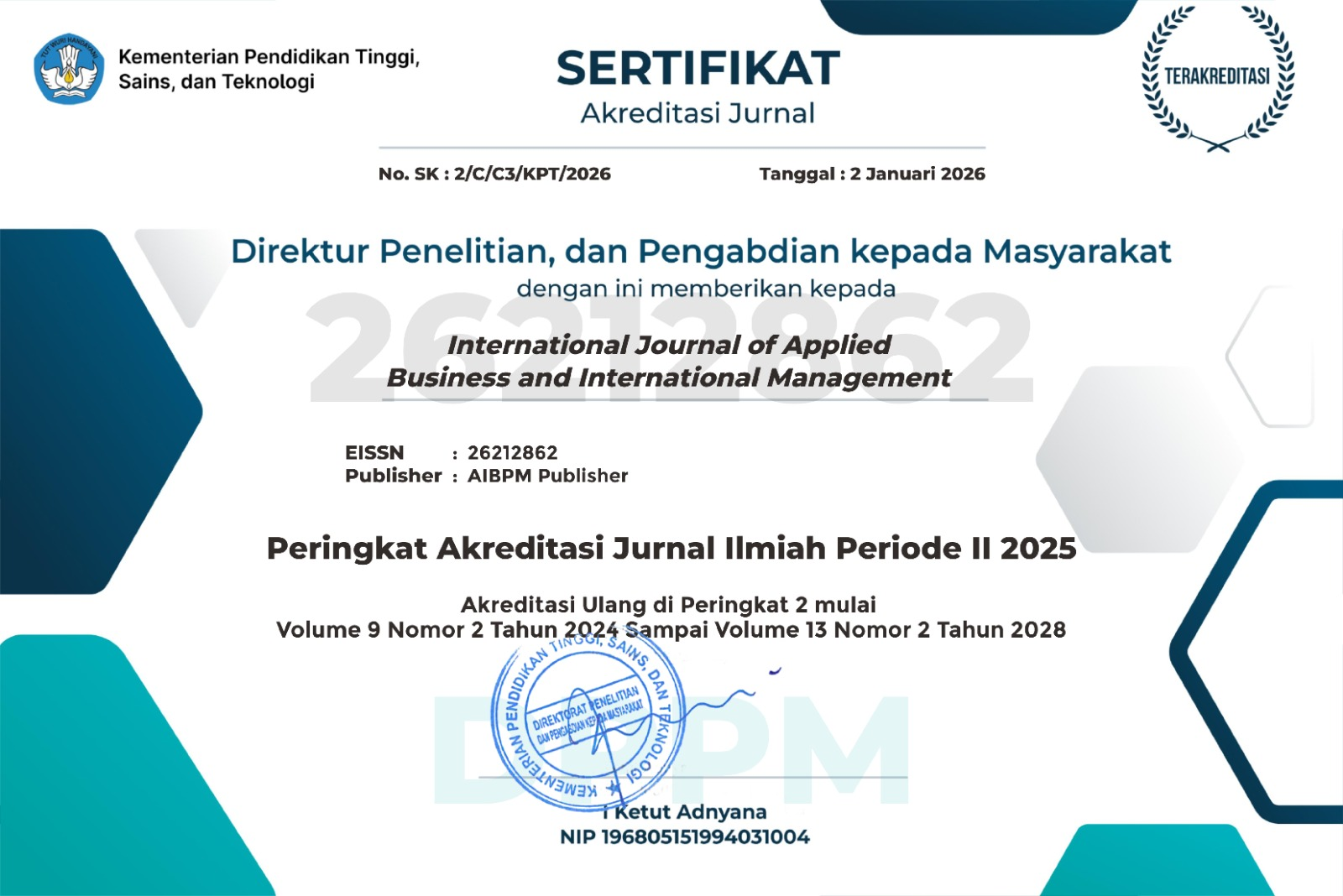
International Journal of Applied Business and International Management (IJABIM)
ISSN 2614-7432 (Print) | ISSN 2621-2862 (Online)
DOI Prefix: 10.32535 by CrossRef
Published by AIBPM Publisher
JL. Kawi No. 23, Bareng, Kec. Klojen, Kota Malang, Jawa Timur, Indonesia
Email: journal.ijabim@gmail.com
Phone: +62 341 366222
Website: https://aibpmpublisher.com/
Governed by
Association of International Business and Professional Management
Email: admin@aibpm.org
Website: https://www.aibpm.org/


Licensing Information

The International Journal of Applied Business and International Management (IJABIM) is licensed under a Creative Commons Attribution-NonCommercial-ShareAlike 4.0 International License .
Follow Us:

