





 Email this article
 Dynamics of Employee Adaptation, Anxiety, and Role Change Under AI Integration in Indonesia
Abstract
The rapid adoption of artificial intelligence (AI) is transforming Indonesian workplaces, reshaping employees’ perceptions of work, identity, and job security. This study explores employees’ experiences of AI integration, workplace anxiety, readiness for change, and evolving job roles. Guided by the Transactional Theory of Stress and Coping, the Job Demands–Resources model, Change Readiness Theory, Role Theory, and UTAUT, an interpretive phenomenological approach was employed. Eighteen semi-structured interviews were conducted with employees and HR practitioners from banking, manufacturing, and digital-service organizations in Indonesia. Data were triangulated through workplace observations and organizational documents and analyzed using thematic analysis. Five themes emerged: ambivalent perceptions of AI, anxieties over job displacement and surveillance, uneven readiness shaped by digital literacy and psychological safety, role shifts toward analytical and relational work, and the importance of transparent communication and learning culture. The findings demonstrate that successful AI adoption depends on technological implementation, organizational support, psychological safety, AI literacy, and participatory change management.
Keywords
Full Text:
PDFReferences
Acemoglu, D., & Restrepo, P. (2020). Robots and jobs: Evidence from US labor markets. Journal of Political Economy, 128(6), 2188–2244. https://doi.org/10.1086/705716
Andika, I. M. B., & Anindita, R. (2022). Fostering readiness to change through work engagement in Indonesian government organization. International Journal of Social Science and Business, 7(1), 86–95. https://doi.org/10.23887/ijssb.v7i1.48032
Arslan, A., Cooper, C., Khan, Z., Golgeci, I., & Ali, I. (2022). Artificial intelligence and human workers interaction at team level: A conceptual assessment of the challenges and potential HRM strategies. International Journal of Manpower, 43(1), 75–88. https://doi.org/10.1108/IJM-01-2021-0052
Bakker, A. B., Demerouti, E., & Sanz-Vergel, A. (2023). Job demands-resources theory: Ten years later. Annual Review of Organizational Psychology and Organizational Behavior, 10, 25–53. https://doi.org/10.1146/annurev-orgpsych-120920-053933
Bakker, A. B., & Demerouti, E. (2024). Job demands-resources theory: Frequently asked questions. Journal of Occupational Health Psychology, 29(3), 188–200. https://doi.org/10.1037/ocp0000376
Bankins, S. (2021). The ethical use of artificial intelligence in human resource management: A decision-making framework. Ethics and Information Technology, 23(4), 841–854. https://doi.org/10.1007/s10676-021-09619-6
Bankins, S., Ocampo, A. C., Marrone, M., Restubog, S. L. D., & Woo, S. E. (2024). A multilevel review of artificial intelligence in organizations: Implications for organizational behavior research and practice. Journal of Organizational Behavior, 45(2), 159–182. https://doi.org/10.1002/job.2735
Braganza, A., Chen, W., Canhoto, A., & Sap, S. (2021). Productive employment and decent work: The impact of AI adoption on psychological contracts, job engagement and employee trust. Journal of Business Research, 131, 485–494. https://doi.org/10.1016/j.jbusres.2020.08.018
Brougham, D., & Haar, J. (2020). Technological disruption and employment: The influence on job insecurity and turnover intentions. Technological Forecasting and Social Change, 161, 120276. https://doi.org/10.1016/j.techfore.2020.120276
Budhwar, P., Malik, A., De Silva, M. T. T., & Thevisuthan, P. (2022). Artificial intelligence – challenges and opportunities for international HRM: A review and research agenda. The International Journal of Human Resource Management, 33(6), 1065–1097. https://doi.org/10.1080/09585192.2022.2035161
Charlwood, A., & Guenole, N. (2022). Can HR adapt to the paradoxes of artificial intelligence? Human Resource Management Journal, 32(4), 729–742. https://doi.org/10.1111/1748-8583.12433
Chowdhury, S., Budhwar, P., Dey, P. K., Joel-Edgar, S., & Abadie, A. (2022). AI-employee collaboration and business performance: Integrating knowledge-based view, socio-technical systems and organisational socialisation framework. Journal of Business Research, 144, 31–49. https://doi.org/10.1016/j.jbusres.2022.01.069
Chowdhury, S., Dey, P., Joel-Edgar, S., Bhattacharya, S., Rodriguez-Espindola, O., Abadie, A., & Truong, L. (2023). Unlocking the value of artificial intelligence in human resource management through AI capability framework. Human Resource Management Review, 33(1), 100899. https://doi.org/10.1016/j.hrmr.2022.100899
Demerouti, E., & Bakker, A. B. (2023). Job demands-resources theory in times of crises: New propositions. Organizational Psychology Review, 13(3), 209–236. https://doi.org/10.1177/20413866221135022
Höyng, M., & Lau, A. (2023). Being ready for digital transformation: How to enhance employees' intentional digital readiness. Computers in Human Behavior Reports, 11, 100314. https://doi.org/10.1016/j.chbr.2023.100314
Jewapatarakul, D., & Ueasangkomsate, P. (2024). Digital organizational culture, organizational readiness, and knowledge acquisition affecting digital transformation in SMEs from food manufacturing sector. SAGE Open, 14(4). https://doi.org/10.1177/21582440241297405
Jia, N., Luo, X., Fang, Z., & Liao, C. (2024). When and how artificial intelligence augments employee creativity. Academy of Management Journal, 67(1), 5–32. https://doi.org/10.5465/amj.2022.0426
Kim, Y., Blazquez, V., & Oh, T. (2024). Determinants of generative AI system adoption and usage behavior in Korean companies: Applying the UTAUT model. Behavioral Sciences, 14(11), 1035. https://doi.org/10.3390/bs14111035
Köchling, A., & Wehner, M. C. (2023). Better explaining the benefits why AI? Analyzing the impact of explanations on employees' organizational identification toward AI in human resource management. International Journal of Selection and Assessment, 31(2), 252–269. https://doi.org/10.1111/ijsa.12430
Kong, H., Yuan, Y., Baruch, Y., Bu, N., Jiang, X., & Wang, K. (2021). Influences of artificial intelligence (AI) awareness on career competency and job burnout. International Journal of Contemporary Hospitality Management, 33(2), 717–734. https://doi.org/10.1108/IJCHM-07-2020-0789
Liang, X., Guo, G., Shu, L., Gong, Q., & Luo, P. (2022). Investigating the double-edged sword effect of AI awareness on employee's service innovative behavior. Tourism Management, 92, 104564. https://doi.org/10.1016/j.tourman.2022.104564
Lingmont, D. N. J., & Alexiou, A. (2020). The contingent effect of job automating technology awareness on perceived job insecurity: Exploring the moderating role of organizational culture. Technological Forecasting and Social Change, 161, 120302. https://doi.org/10.1016/j.techfore.2020.120302
Malik, A., Budhwar, P., Patel, C., & Srikanth, N. R. (2022). May the bots be with you! Delivering HR cost-effectiveness and individualised employee experiences in an MNE. The International Journal of Human Resource Management, 33(6), 1148–1178. https://doi.org/10.1080/09585192.2020.1859582
Malik, A., Budhwar, P., & Kazmi, B. A. (2023). Artificial intelligence (AI)-assisted HRM: Towards an extended strategic framework. Human Resource Management Review, 33(1), 100940. https://doi.org/10.1016/j.hrmr.2022.100940
Mariani, M. M., Machado, I., Magrelli, V., & Dwivedi, Y. K. (2023). Artificial intelligence in innovation research: A systematic review, conceptual framework, and future research directions. Technovation, 122, 102623. https://doi.org/10.1016/j.technovation.2022.102623
Naeem, M., Ozuem, W., Howell, K., & Ranfagni, S. (2023). A step-by-step process of thematic analysis to develop a conceptual model in qualitative research. International Journal of Qualitative Methods, 22, 1–18. https://doi.org/10.1177/16094069231205789
Pan, Y., & Froese, F. J. (2023). An interdisciplinary review of AI and HRM: Challenges and future directions. Human Resource Management Review, 33(1), 100924. https://doi.org/10.1016/j.hrmr.2022.100924
Parent-Rocheleau, X., & Parker, S. K. (2022). Algorithms as work designers: How algorithmic management influences the design of jobs. Human Resource Management Review, 32(3), 100838. https://doi.org/10.1016/j.hrmr.2021.100838
Pereira, V., Hadjielias, E., Christofi, M., & Vrontis, D. (2023). A systematic literature review on the impact of artificial intelligence on workplace outcomes: A multi-process perspective. Human Resource Management Review, 33(1), 100857. https://doi.org/10.1016/j.hrmr.2021.100857
Presbitero, A., & Teng-Calleja, M. (2023). Job attitudes and career behaviors relating to employees' perceived incorporation of artificial intelligence in the workplace: A career self-management perspective. Personnel Review, 52(4), 1169–1187. https://doi.org/10.1108/PR-02-2021-0103
Prikshat, V., Malik, A., & Budhwar, P. (2023). AI-augmented HRM: Antecedents, assimilation and multilevel consequences. Human Resource Management Review, 33(1), 100860. https://doi.org/10.1016/j.hrmr.2021.100860
Soulami, M., Benchekroun, S., & Galiulina, A. (2024). Exploring how AI adoption in the workplace affects employees: A bibliometric and systematic review. Frontiers in Artificial Intelligence, 7, 1473872. https://doi.org/10.3389/frai.2024.1473872
Sp?taru, B., Podin?, I. R., Tulbure, B. T., & Maricu?oiu, L. P. (2024). A longitudinal examination of appraisal, coping, stress, and mental health in students: A cross-lagged panel network analysis. Stress and Health, 40(5), e3450. https://doi.org/10.1002/smi.3450
Suseno, Y., Chang, C., Hudik, M., & Fang, E. S. (2022). Beliefs, anxiety and change readiness for artificial intelligence adoption among human resource managers: The moderating role of high-performance work systems. The International Journal of Human Resource Management, 33(6), 1209–1236. https://doi.org/10.1080/09585192.2021.1931408
Tang, P. M., Koopman, J., McClean, S. T., Zhang, J. H., Li, C. H., De Cremer, D., Lu, Y., & Ng, C. T. S. (2022). When conscientious employees meet intelligent machines: An integrative approach inspired by complementarity theory and role theory. Academy of Management Journal, 65(3), 1019–1054. https://doi.org/10.5465/amj.2020.1516
Teng, R., Zhou, S., Zheng, W., & Ma, C. (2024). Artificial intelligence (AI) awareness and work withdrawal: Evaluating chained mediation through negative work-related rumination and emotional exhaustion. International Journal of Contemporary Hospitality Management, 36(7), 2311–2326. https://doi.org/10.1108/IJCHM-02-2023-0240
Trenerry, B., Chng, S., Wang, Y., Suhaila, Z. S., Lim, S. S., Lu, H. Y., & Oh, P. H. (2021). Preparing workplaces for digital transformation: An integrative review and framework of multi-level factors. Frontiers in Psychology, 12, 620766. https://doi.org/10.3389/fpsyg.2021.620766
Tursunbayeva, A., Pagliari, C., Di Lauro, S., & Antonelli, G. (2022). The ethics of people analytics: Risks, opportunities and recommendations. Personnel Review, 51(3), 900–921. https://doi.org/10.1108/PR-12-2019-0680
Tursunbayeva, A., & Renkema, M. (2023). Artificial intelligence in health-care: Implications for the job design of healthcare professionals. Asia Pacific Journal of Human Resources, 61(4), 845–887. https://doi.org/10.1111/1744-7941.12325
Venkatesh, V. (2022). Adoption and use of AI tools: A research agenda grounded in UTAUT. Annals of Operations Research, 308(1–2), 641–652. https://doi.org/10.1007/s10479-020-03918-9
Vrontis, D., Christofi, M., Pereira, V., Tarba, S., Makrides, A., & Trichina, E. (2022). Artificial intelligence, robotics, advanced technologies and human resource management: A systematic review. The International Journal of Human Resource Management, 33(6), 1237–1266. https://doi.org/10.1080/09585192.2020.1871398
Walczok, M., & Bipp, T. (2024). Understanding the emergence and trajectory of job insecurity due to smart technology, artificial intelligence, robotics, and automation. Human Factors and Ergonomics in Manufacturing & Service Industries. https://doi.org/10.1002/hfm.70000
Wijayati, D. T., Rahman, Z., Fahrullah, A., Rahman, M. F. W., Arifah, I. D. C., & Kautsar, A. (2022). A study of artificial intelligence on employee performance and work engagement: The moderating role of change leadership. International Journal of Manpower, 43(2), 486–512. https://doi.org/10.1108/IJM-07-2021-0423
Wu, T.-J., Liang, Y., & Wang, Y. (2024). The buffering role of workplace mindfulness: How job insecurity of human-artificial intelligence collaboration impacts employees' work–life-related outcomes. Journal of Business and Psychology, 39(6), 1395–1415. https://doi.org/10.1007/s10869-024-09947-6
Yam, K. C., Tang, P. M., Jackson, J. C., Su, R., & Gray, K. (2023). The rise of robots increases job insecurity and maladaptive workplace behaviors: Multimethod evidence. Journal of Applied Psychology, 108(5), 850–871. https://doi.org/10.1037/apl0001045
Zhang, Y., Liu, X., Yan, Q., & Na, M. (2025). Empowering workforces in AI-driven environments: Co-skilling, organizational support, and mitigating job insecurity. Frontiers in Psychology, 16, 1700129. https://doi.org/10.3389/fpsyg.2025.1700129
DOI: https://doi.org/10.32535/ijabim.v11i2.4658
Refbacks
- There are currently no refbacks.

Copyright (c) 2026 RICHA AFRIANA MUNTHE

This work is licensed under a Creative Commons Attribution-NonCommercial-ShareAlike 4.0 International License.
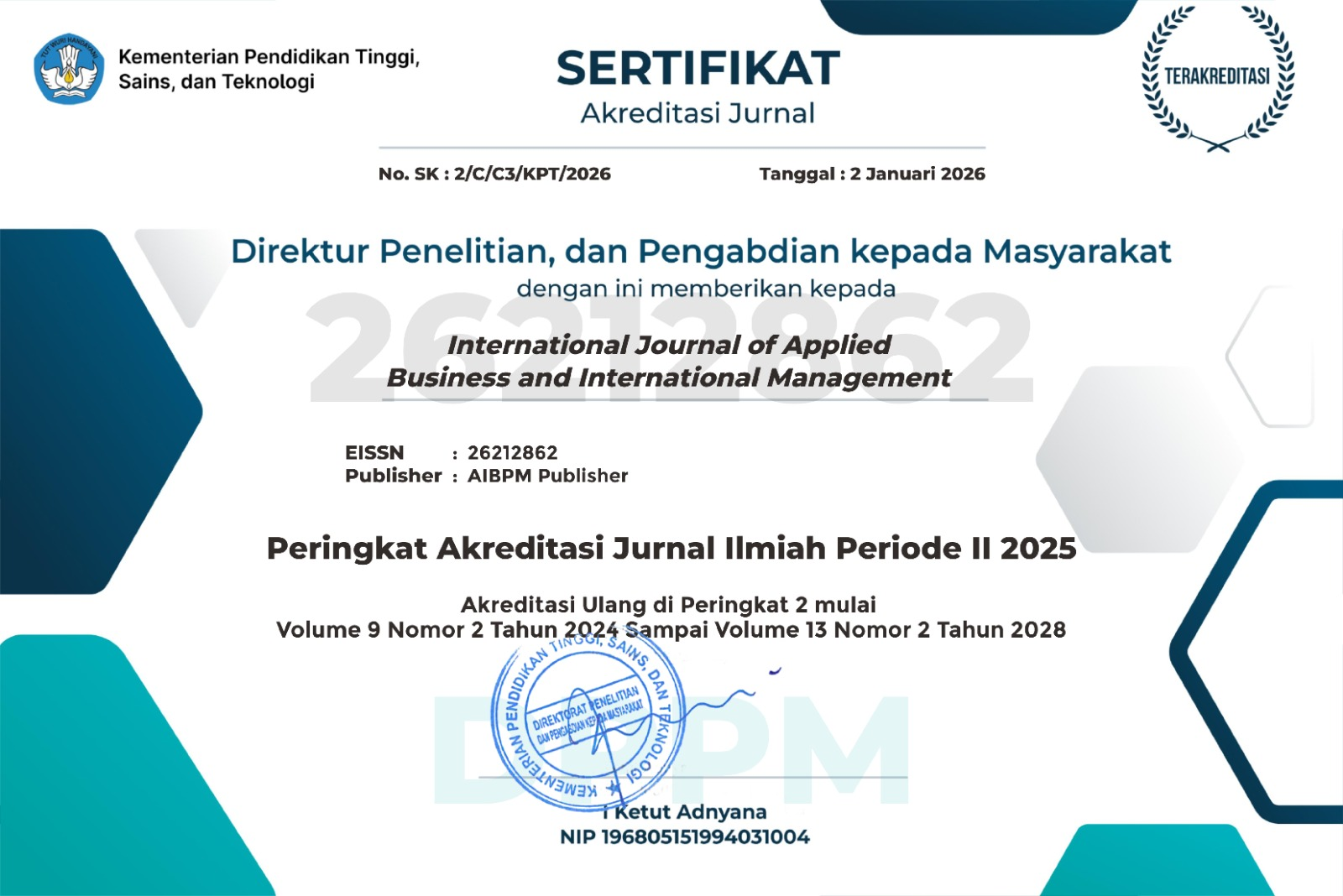
International Journal of Applied Business and International Management (IJABIM)
ISSN 2614-7432 (Print) | ISSN 2621-2862 (Online)
DOI Prefix: 10.32535 by CrossRef
Published by AIBPM Publisher
JL. Kawi No. 23, Bareng, Kec. Klojen, Kota Malang, Jawa Timur, Indonesia
Email: journal.ijabim@gmail.com
Phone: +62 341 366222
Website: https://aibpmpublisher.com/
Governed by
Association of International Business and Professional Management
Email: admin@aibpm.org
Website: https://www.aibpm.org/


Licensing Information

The International Journal of Applied Business and International Management (IJABIM) is licensed under a Creative Commons Attribution-NonCommercial-ShareAlike 4.0 International License .
Follow Us:

