





 Email this article
 Risk at the Top: Board Demographics, Political Affiliation, and Bank Risk-Taking in Indonesia
Abstract
Indonesia's heavy reliance on bank intermediation makes the demographic composition of bank boards a first-order governance concern, yet board-level determinants of risk-taking remain underexplored relative to structural factors. This study aims to identify which board characteristics systematically shift risk-weighted assets (RWA) among 46 banks listed on the Indonesia Stock Exchange, observed from 2015 to 2024, by comparing banks that experienced a board-composition change with matched banks that did not across a five-year event window. This quantitative, quasi-experimental study uses a difference-in-differences (DiD) design to examine how board age, gender, education, and political affiliation affect bank risk-taking in Indonesia. The DiD estimates show that a younger board (b = 4.53, p < 0.05), a higher share of female directors (b = 7.32, p < 0.05), and a higher share of politically affiliated directors (b = 9.27, p < 0.10) each raise risk-taking, while a higher share of directors holding master's or doctoral degrees lowers it (b = -6.26, p < 0.05). These findings indicate that bank risk-taking is shaped as much by who sits on the board as by organizational structure, offering regulators a demographic lens for strengthening governance oversight.
Full Text:
PDFReferences
Antonakakis, N., Breitenlechner, M., & Scharler, J. (2015). Business cycle and financial cycle spillovers in the G7 countries. Quarterly Review of Economics and Finance, 58, 154–162. https://doi.org/10.1016/j.qref.2015.03.002
Anwar, C. J., Okot, N., Suhendra, I., Indriyani, D., & Jie, F. (2024). Monetary policy, macroprudential policy, and bank risk-taking behaviour in the Indonesian banking industry. Journal of Applied Economics, 27(1). https://doi.org/10.1080/15140326.2023.2295732
Ashraf, B. N., Zheng, C., & Arshad, S. (2016). Effects of national culture on bank risk-taking behavior. Research in International Business and Finance, 37, 309–326. https://doi.org/10.1016/j.ribaf.2016.01.015
Aureli, S., & Brighi, P. (2025). Gender, age, and nationality diversity in banks’ board: Do they affect financial and sustainability performance? In P. Paoloni (Ed.), Shaping tomorrow: Gender perspectives in a sustainable world (pp. 3–21). Springer Nature Switzerland.
Gulamhussen, M. A., & Santa, S. F. (2015). Female directors in bank boardrooms and their influence on performance and risk-taking. Global Finance Journal, 28, 10–23.
Barber, B. M., & Odean, T. (2001). Boys will be boys: Gender, overconfidence, and common stock investment. The Quarterly Journal of Economics, 116(1), 261–292.
Barsky, R. B., Kimball, M. S., Juster, F. T., & Shapiro, M. D. (1995). Preference parameters and behavioral heterogeneity: An experimental approach in the Health and Retirement Survey (NBER Working Paper No. 5213). National Bureau of Economic Research.
Beck, T., Behr, P., & Güttler, A. (2013). Gender and banking: Are women better loan officers? Review of Finance, 17(4), 1279–1321.
Berger, A. N., Kick, T., & Schaeck, K. (2014). Executive board composition and bank risk taking. Journal of Corporate Finance, 28, 48–65. https://doi.org/10.1016/j.jcorpfin.2013.11.006
Bertay, A. C., Demirgüç-Kunt, A., & Huizinga, H. (2015). Bank ownership and credit over the business cycle: Is lending by state banks less procyclical? Journal of Banking and Finance, 50, 326–339. https://doi.org/10.1016/j.jbankfin.2014.03.012
Bertrand, M., & Schoar, A. (2003). Managing with style: The effect of managers on firm policies. The Quarterly Journal of Economics, 118(4), 1169–1208.
Boateng, A., Liu, Y., & Brahma, S. (2019). Politically connected boards, ownership structure and credit risk: Evidence from Chinese commercial banks. Research in International Business and Finance, 47, 162–173. https://doi.org/10.1016/j.ribaf.2018.07.008
Braham, R., de Peretti, C., & Belkacem, L. (2020). The role of political patronage in the risk-taking behaviour of banks in the Middle East and North Africa. Research in International Business and Finance, 53. https://doi.org/10.1016/j.ribaf.2020.101184
Bucciol, A., & Miniaci, R. (2011). Household Portfolios And Implicit Risk Preference. Review of Economics and Statistics, 93(4), 1235–1250. https://doi.org/10.1162/REST_a_00138
Campbell, J. Y. (2006). Household finance. The Journal of Finance, 61(4), 1553–1604.
Caprio, G., & Honohan, P. (2003). Banking policy and macroeconomic stability: An exploration. World Bank.
Cid-Aranda, C., & López-Iturriaga, F. (2023). C.E.O. characteristics and corporate risk-taking: evidence from emerging markets. Economic Research-Ekonomska Istrazivanja , 36(2). https://doi.org/10.1080/1331677X.2023.2175008
Courtemanche, C. J., & Zapata, D. (2012). Does Universal Coverage Improve Health? The Massachusetts Experience (NBER Working Paper No. 17893). National Bureau of Economic Research. http://www.nber.org/papers/w17893
Faccio, M. (2006). Politically connected firms. American Economic Review, 96(1), 369–386.
Farrell, K. A., & Hersch, P. L. (2005). Additions to corporate boards: The effect of gender. Journal of Corporate Finance, 11(1–2), 85–106. https://doi.org/10.1016/j.jcorpfin.2003.12.001
Fisman, R. (2001). Estimating the Value of Political Connections. In Source: The American Economic Review (Vol. 91, Number 4). http://www.jstor.orgURL:http://www.jstor.org/stable/2677829
Fredriksson, A., & Oliveira, G. M. de. (2019). Impact evaluation using Difference-in-Differences. RAUSP Management Journal, 54(4), 519–532. https://doi.org/10.1108/RAUSP-05-2019-0112
Grable, J. E. (2000). Financial Risk Tolerance And Additional Factors That Affect Risk Taking In Everyday Money Matters. In Journal Of Business And PsychologY (Vol. 14, Number 4).
Graham, J. R., & Harvey, C. R. (2001). The theory and practice of corporate finance: Evidence from the field. Journal of Financial Economics, 60(2–3), 187–243.
Hambrick, D. C. (2007). Upper echelons theory: An update. Academy of Management Review, 32(2), 334–343.
Hambrick, D. C., & Mason, P. A. (1984). Upper echelons: The organization as a reflection of its top managers. Academy of Management Review, 9(2), 193–206.
Hertrampf, P., Brunner-Kirchmair, T. M., Hiebl, M. R. W., & Wiedemann, A. (2025). The Relationship Between CEO Characteristics and Banks’ Risk-Taking: Review and Research Directions. In Schmalenbach Journal of Business Research (Vol. 77, Number 1, pp. 127–178). Springer Science and Business Media B.V. https://doi.org/10.1007/s41471-024-00199-x
Javed M, Mehmood K, Ghafoor A, Parveen A (2024), Board structure and risk-taking behavior: evidence from the financial sector of Pakistan. Corporate Governance, Vol. 24 No. 5 pp. 1060–1082, doi: https://doi.org/10.1108/CG-03-2023-0101
Jianakoplos, N. A., & Bernasek, A. (1998). Are women more risk averse? Economic Inquiry, 36(4), 620–630.
Keiko Hubbansyah, A., & Ananto Husodo, Z. (2018). The Interdependence Between The Financial Sector And Business Sector In Asean 4 Countries. Journal of Indonesian Economy and Business, 33(1), 77–94. http://journal.ugm.ac.id/jieb
Khwaja, A. I., & Mian, A. (2005). Do lenders favor politically connected firms? Rent provision in an emerging financial market. The Quarterly Journal of Economics, 120(4), 1371–1411.
Krishnan, K., Nandy, D., & Puri, M. (2014). Does financing spur small business productivity? Evidence from a natural experiment (NBER Working Paper No. 20149). National Bureau of Economic Research.
Laeven, L., & Levine, R. (2009). Bank governance, regulation and risk taking. Journal of Financial Economics, 93(2), 259–275. https://doi.org/10.1016/j.jfineco.2008.09.003
Lambert, T., Wagner, W., & Zhang, E. Q. (2023). Banks, Political Capital, and Growth. Review of Corporate Finance Studies, 12(3), 613–655. https://doi.org/10.1093/rcfs/cfac005
MacCrimmon, K. R., & Wehrung, D. A. (1990). Characteristics of Risk Taking Executives. Management Science, 36(4), 422–435. https://doi.org/10.1287/mnsc.36.4.422
La Porta, R., Lopez-de-Silanes, F., & Shleifer, A. (2002). Government ownership of banks. The Journal of Finance, 57(1), 265–301.
Nainggolan, Y. A., Prahmila, D. I., & Syaputri, A. R. (2023). Do board characteristics affect bank risk-taking and performance? Evidence from Indonesian and Malaysian Islamic banks. Journal of Management and Governance, 27(4), 1115–1145. https://doi.org/10.1007/s10997-022-09625-w
Neisen, M., & Röth, S. (2018). Basel IV: The next generation of risk weighted assets. John Wiley & Sons.
Önder, Z., & Özyildirim, S. (2013). Role of bank credit on local growth: Do politics and crisis matter? Journal of Financial Stability, 9(1), 13–25. https://doi.org/10.1016/j.jfs.2012.12.002
Pathan, S. (2009). Strong boards, CEO power and bank risk-taking. Journal of Banking and Finance, 33(7), 1340–1350. https://doi.org/10.1016/j.jbankfin.2009.02.001
Psillaki, M., Mavrakana, C., Hasannasab, M., & Margaritis, D. (2024). Board gender diversity, risk culture and bank performance: Evidence from European banks (University of Auckland Business School Research Paper Series). SSRN. https://ssrn.com/abstract=4767508
Rachdi, H., & Ben Ameur, I. G. (2011). Board Characteristics, Performance and Risk Taking Behaviour in Tunisian Banks. International Journal of Business and Management, 6(6). https://doi.org/10.5539/ijbm.v6n6p88
Rahmizal, M., Yusra, I., & Sari, L. (2022). Pengaruh likuiditas pendanaan terhadap pengambilan risiko pada Bank Perkreditan Rakyat Syariah di Indonesia. Jurnal Kajian Manajemen Bisnis, 11(2), 101–110.
Sahm, C., Sahm, C. R., Shapiro, M., Kimball, M., Solon, G., Shumway, T., Willis, B., Benjamin, D., House, C., Laibson, D., Rabin, M., & Thaler, R. (2007). How Much Does Risk Tolerance Change? Stability of Risk Preference. http://hrsonline.isr.umich.edu.
Schnabl, P. (2012). The International Transmission of Bank Liquidity Shocks: Evidence from an Emerging Market. In THE JOURNAL OF FINANCE •: LXVII (Number 3).
Setiyono, B., & Tarazi, A. (2018). Does diversity of bank board members affect performance and risk? Evidence from an emerging market. https://unilim.hal.science/hal-01070988v1
Shaban, M., & James, G. A. (2018). The effects of ownership change on bank performance and risk exposure: Evidence from indonesia. Journal of Banking and Finance, 88, 483–497. https://doi.org/10.1016/j.jbankfin.2017.02.002
Stellingwerf, N. (2016). The Influence Of Board Gender Diversity On Corporate Risk Taking In US Non-Financial Firms.
Tri, S., Hendra, N., & Hartomo, D. D. (2017). Pengaruh Konsentrasi Dan Pangsa Pasar Terhadap Pengambilan Resiko Bank.
Veronica, R., & Andrew, V. (2017). Keterkaitan kompetisi dan stabilitas perbankan. Prosiding Seminar Nasional dan Call for Paper Ekonomi dan Bisnis.
DOI: https://doi.org/10.32535/ijabim.v11i2.4702
Refbacks
- There are currently no refbacks.

Copyright (c) 2026 Aulia Keiko Hubbansyah

This work is licensed under a Creative Commons Attribution-NonCommercial-ShareAlike 4.0 International License.
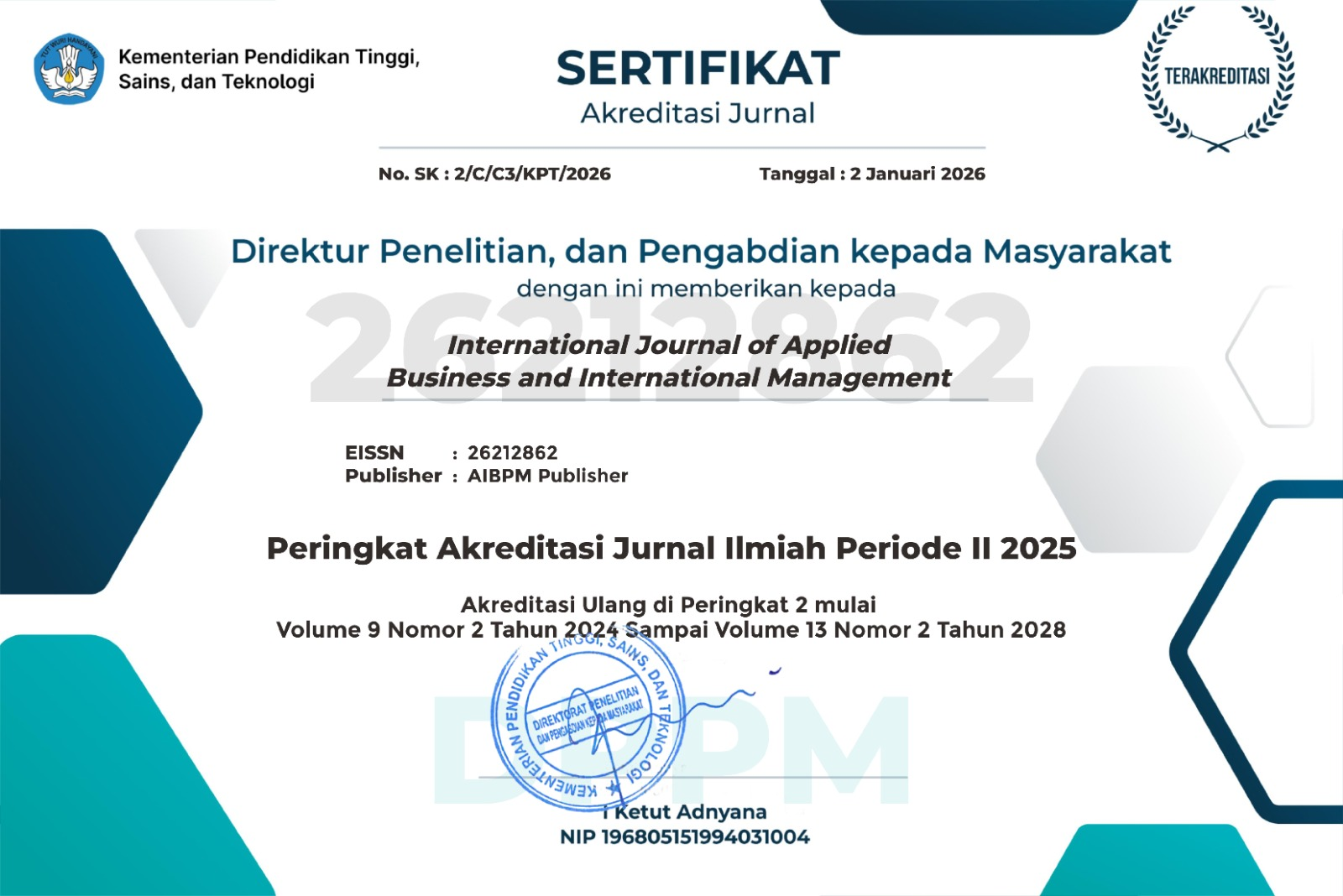
International Journal of Applied Business and International Management (IJABIM)
ISSN 2614-7432 (Print) | ISSN 2621-2862 (Online)
DOI Prefix: 10.32535 by CrossRef
Published by AIBPM Publisher
JL. Kawi No. 23, Bareng, Kec. Klojen, Kota Malang, Jawa Timur, Indonesia
Email: journal.ijabim@gmail.com
Phone: +62 341 366222
Website: https://aibpmpublisher.com/
Governed by
Association of International Business and Professional Management
Email: admin@aibpm.org
Website: https://www.aibpm.org/


Licensing Information

The International Journal of Applied Business and International Management (IJABIM) is licensed under a Creative Commons Attribution-NonCommercial-ShareAlike 4.0 International License .
Follow Us:

