





 Email this article
 Beyond ESG Adoption: How Value Co-Creation and Community Engagement Transform Sustainability Practices into Business Performance in Creative SMEs
Abstract
Keywords
Full Text:
PDFReferences
Amsal, J. F., & Hastuti, T. D. (2025). The implementation of ESG practices: A case study of Batik small and medium-sized enterprises in Lasem. Jurnal Akuntansi Bisnis, 23(1), 77–100.
Appiah, L. O., Essuman, D., Forson, C. A., Boso, N., & Annan, J. (2025). Green process innovation and financial performance in small and medium-sized enterprises in a developing country: Role of resource orchestration. Journal of Business Research, 189, 115210. https://doi.org/10.1016/j.jbusres.2025.115210
Badan Pusat Statistik. (2025, November 17). BPS: Creative economy employs 27.4 million workers in 2025. BPS-Statistics Indonesia. https://www.bps.go.id/en/news/2025/11/17/805/bps--creative-economy-employs-27-4-million-workers-in-2025.html
Barney, J. (1991). Firm resources and sustained competitive advantage. Journal of Management, 17(1), 99–120. https://doi.org/10.1177/014920639101700108
Chin, W. W. (1998). The partial least squares approach to structural equation modeling. In G. A. Marcoulides (Ed.), Modern methods for business research (pp. 295–336). Lawrence Erlbaum Associates.
Csapi et al. (2026). Do ESG-related managerial capabilities pay off for SMEs? Evidence from the Small and Medium-Sized Enterprise ESG Capability Measure (SM-ESG). Corporate Social Responsibility and Environmental Management.
Donaldson, T., & Preston, L. E. (1995). The stakeholder theory of the corporation: Concepts, evidence, and implications. Academy of Management Review, 20(1), 65–91. https://doi.org/10.5465/amr.1995.9503271992
Freeman, R. E. (1984). Strategic management: A stakeholder approach. Pitman.
Gennari, F., & Salvioni, D. M. (2019). CSR committees on boards: The impact of the external country level factors. Journal of Management and Governance, 23(3), 759–785. https://doi.org/10.1007/s10997-018-9442-8
Goodman, M. S., Sanders Thompson, V. L., Johnson, C. A., Gennarelli, R., Drake, B. F., Bajwa, P., Witherspoon, M., & Bowen, D. (2017). Evaluating community engagement in research: Quantitative measure development. Journal of Community Psychology, 45(1), 17–32. https://doi.org/10.1002/jcop.21828
Hair, J. F., Jr., Black, W. C., Babin, B. J., & Anderson, R. E. (2019). Multivariate data analysis (8th ed.). Cengage.
Hair, J. F., Jr., Howard, M. C., & Nitzl, C. (2020). Assessing measurement model quality in PLS-SEM using confirmatory composite analysis. Journal of Business Research, 109, 101–110. https://doi.org/10.1016/j.jbusres.2019.11.069
Hughes, M., Hughes, P., Hodgkinson, I., Chang, Y. Y., & Chang, C. Y. (2022). Knowledge-based theory, entrepreneurial orientation, stakeholder engagement, and firm performance. Strategic Entrepreneurship Journal, 16, 633–665. This study explicitly connects stakeholder engagement with firm performance.
Jiang, Y., & Lin, H. (2026). Bridging sustainability and value co-creation: The financial and strategic role of ESG performance. International Review of Economics & Finance, 105, 104861. https://doi.org/10.1016/j.iref.2025.104861
Matarazzo, M., Oduro, S., & Gennaro, A. (2025). Stakeholder engagement for sustainable value co-creation: Evidence from Made in Italy SMEs. Business Ethics, the Environment & Responsibility, 34(2), 347–361. https://doi.org/10.1111/beer.12654.
Momtaz, P. P., & Parra, I. M. (2025). Is sustainable entrepreneurship profitable? ESG disclosure and the financial performance of SMEs. Small Business Economics, 64, 1535–1564. https://doi.org/10.1007/s11187-024-00981-5
Pramono, T., Nugroho, Y. A., Waruwu, H., Fauji, A., & Jainuri. (2026). Integrating ESG principles in MSME management: A qualitative study of governance and accountability in Banten, Indonesia.
Suchman, M. C. (1995). Managing legitimacy: Strategic and institutional approaches. Academy of Management Review, 20(3), 571–610. https://doi.org/10.5465/amr.1995.9508080331
Torugsa, N. A., O’Donohue, W., & Hecker, R. (2013). Proactive CSR: An empirical analysis of the role of its economic, social and environmental dimensions on the association between capabilities and performance. Journal of Business Ethics, 115(2), 383–402. https://doi.org/10.1007/s10551-012-1405-4
Tsai, F.-S., Cabrilo, S., Chou, H.-H., Hu, F., & Tang, A. D. (2022). Open innovation and SME performance: The roles of reverse knowledge sharing and stakeholder relationships. Journal of Business Research, 148, 433–443. https://doi.org/10.1016/j.jbusres.2022.03.051
Vargo, S. L., & Lusch, R. F. (2004). Evolving to a new dominant logic for marketing. Journal of Marketing, 68(1), 1–17. https://doi.org/10.1509/jmkg.68.1.1.24036
Vargo, S. L., & Lusch, R. F. (2008). Service-dominant logic: Continuing the evolution. Journal of the Academy of Marketing Science, 36(1), 1–10. https://doi.org/10.1007/s11747-007-0069-6
Vargo, S. L., & Lusch, R. F. (2016). Institutions and axioms: An extension and update of service-dominant logic. Journal of the Academy of Marketing Science, 44(1), 5–23. https://doi.org/10.1007/s11747-015-0456-3
Venkatraman, N., & Ramanujam, V. (1986). Measurement of business performance in strategy research: A comparison of approaches. Academy of Management Review, 11(4), 801–814. https://doi.org/10.5465/AMR.1986.4283976
Wati, V. I., & Hermawan, M. S. (2025). Empowering communities: Unraveling the social pillar of ESG in Indonesia's agricultural sector. Pakistan Journal of Life and Social Sciences, 23(1), 3889–3900
Wernerfelt, B. (1984). A resource-based view of the firm. Strategic Management Journal, 5(2), 171–180. https://doi.org/10.1002/smj.4250050207
Wulandari, S. S., Daiman, Malaihollo, C. A., Syakyakirti, Tanubrata, D., & Pratiwi, D. I. (2025). Building long-term value: A practical guide to integrating ESG into business strategies. Sustainable Futures, 10, 100955. https://doi.org/10.1016/j.sftr.2025.100955
Yi, Y., & Gong, T. (2013). Customer value co-creation behavior: Scale development and validation. Journal of Business Research, 66(9), 1279–1284. https://doi.org/10.1016/j.jbusres.2012.02.026
DOI: https://doi.org/10.32535/ijabim.v11i2.5062
Refbacks
- There are currently no refbacks.

Copyright (c) 2026 Sri Ismulyati, Ginta Ginting, Andryansah Andryansah

This work is licensed under a Creative Commons Attribution-NonCommercial-ShareAlike 4.0 International License.
International Journal of Applied Business and International Management (IJABIM)
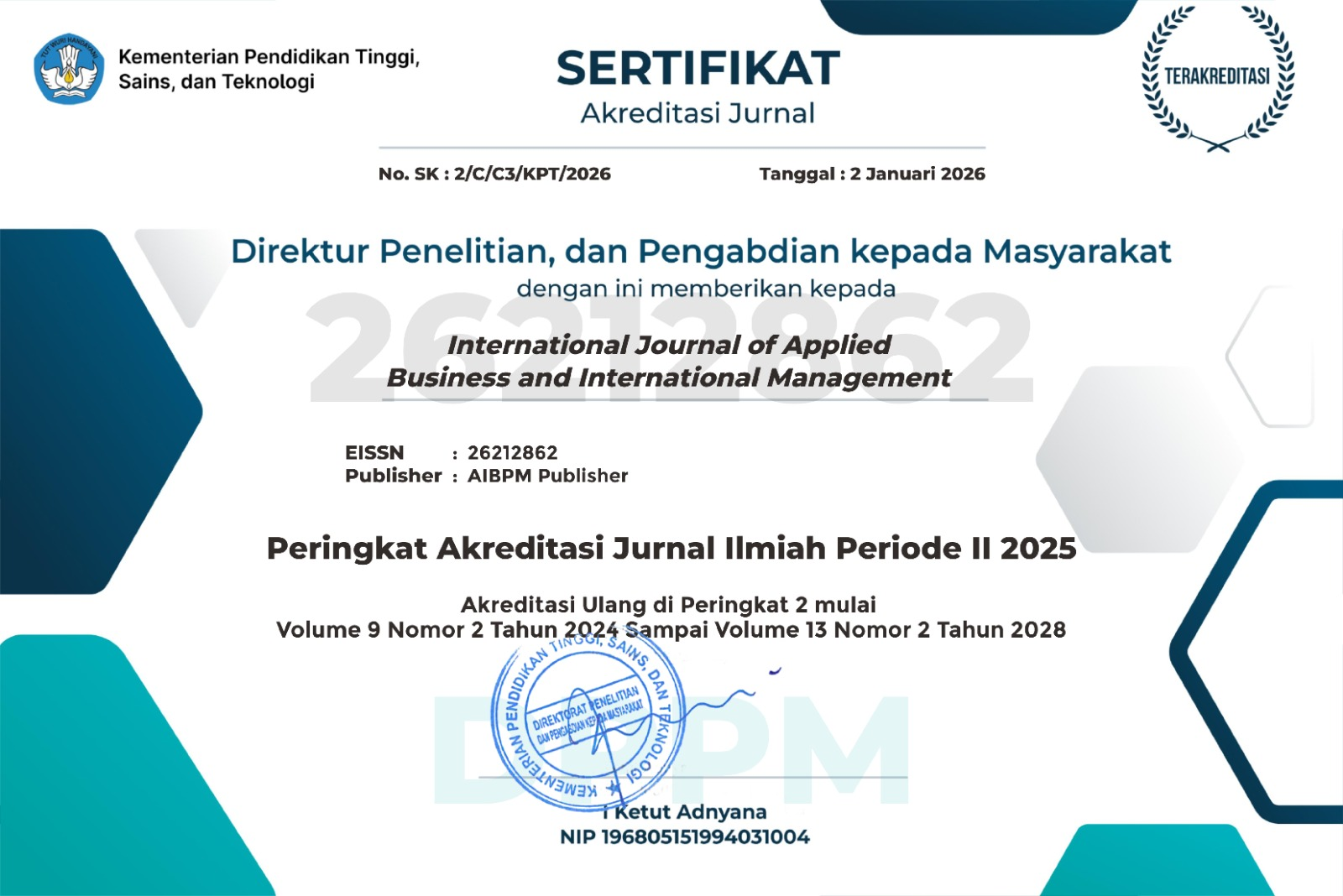
ISSN 2614-7432 (Print) | ISSN 2621-2862 (Online)
DOI Prefix: 10.32535 by CrossRef
Published by AIBPM Publisher
JL. Kawi No. 23, Bareng, Kec. Klojen, Kota Malang, Jawa Timur, Indonesia
Email: journal.ijabim@gmail.com
Phone: +62 341 366222
Website: https://aibpmpublisher.com/
Governed by
Association of International Business and Professional Management
Email: admin@aibpm.org
Website: https://www.aibpm.org/


Licensing Information

The International Journal of Applied Business and International Management (IJABIM) is licensed under a Creative Commons Attribution-NonCommercial-ShareAlike 4.0 International License .
Follow Us:

